European
European
MMake all transport modes more sustainable.
MMake sustainable alternatives widely available
European Green Deal and EU Sustainable and Smart Mobility Strategy
in a multi-modal transport system.
MPut in place the right incentives to drive the
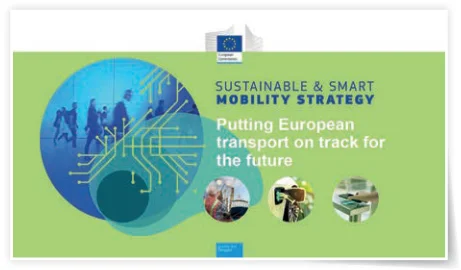
Figure from page 21
transition.
The strategy sets out a four year action plan structured around 10 key flagship areas for action. The vision, principles and goals of this Policy align with a number of the flagships, in particular Flagship 3: Making interurban and urban mobility more sustainable and healthy; Flagship 6: Making connected and automated multi-modal mobility a reality; Flagship 7: Innovation, data and artificial intelligence for smarter mobility; Flagship 9: Making mobility fair and just for all; and Flagship 10 Enhancing transport safety and security. The strategy proposes that all large and medium sized cities should put in place sustainable urban mobility plans by 2030 to address challenges such as congestion, air/noise pollution, climate change, road collisions, on-street parking and the integration of new mobility services.
The European Green Deal was published by the European Commission in 2019 and is a roadmap for making the European Union’s (EU) economy environmentally sustainable. It outlines the actions and targets needed to make Europe the first climate-neutral continent by 2050. As an intermediate step towards climate neutrality, the EU has raised its 2030 climate ambition committing to cutting emissions by at least 55% by 2030 which is known as the Fit for 55 package. The EU is working on the revision of its climate, energy and transport-related legislation under the Fit for 55 package in order to align current laws with the 2030 and 2050 ambitions.
European Urban Mobility Framework
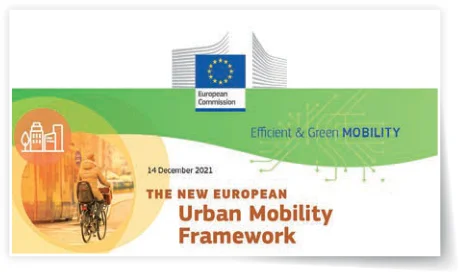
Figure from page 21
The European Commission subsequently launched its Sustainable and Smart Mobility Strategy in 2020. It aims to put the EU on the path to creating a sustainable, smart and resilient mobility system and bring about the fundamental changes needed to achieve the objectives of the Green Deal. The strategy is structured around three key objectives – making the European transport system sustainable, smart and resilient. It highlights the importance of making mobility available and affordable for all, that rural and remote regions must remain connected, and that European transport must offer good social conditions to its workers and provide attractive jobs. The strategy recognises that in order to meet the sustainability objective and achieve the systematic change required under the EU Green Deal, there is a need to:
The European Urban Mobility Framework was launched by the European Commission in 2021 and sets out guidance on how cities can cut emissions and improve mobility, including through sustainable urban mobility plans. The main focus is on public transport, walking and cycling. The proposal also considers zero-emission solutions for urban fleets, including taxis and ride hailing services, the last mile of urban deliveries, and the construction and modernisation of multimodal hubs, as well as new digital solutions and services.
National Sustainable Mobility Policy | Alignment with existing policies
Pages 21–22 · View in original PDF