Population trends
Population trends
The population of Ireland is projected to reach 5.7 million by 2040 from an estimated 5 million in 2021, with a projected need for at least 550,000 more homes and an economy supporting around 660,000 additional jobs. The NPF sets out targets to manage this population growth in a more balanced way across our three regions – Eastern and Midland; Northern and Western; and Southern - and our five cities of Cork, Dublin, Galway, Limerick and Waterford.
What is transportorientated development?
7
Transport-orientated development is a form of urban development that seeks to maximise the provision of housing, employment, public services and leisure space in close proximity to frequent, highquality transport services. It is a form of development that is friendlier to public transport users, cyclists and pedestrians, and seeks to convert car trips to public and active transport trips. This in turn improves mobility and environmental conditions, and delivers more efficient and sustainable urban development.
The NPF recognises that significant investment is required in both active travel and public transport if these targets are to be achieved. As well as supporting the future growth of Dublin, the NPF sets ambitious growth targets for the four cities of Cork, Galway, Limerick and Waterford to ensure that they grow at twice the pace of Dublin. Improved sustainable mobility within the cities can act as a key growth enabler and support a better quality of life for all, as well as supporting the delivery of housing through a transportorientated development approach.
7 www.nesc.ie/work-programme/land-use-land-value-urban-development/transport-oriented-development/
National Sustainable Mobility Policy | Introduction
Outside of the five cities, the NPF targets 50% of sustainable growth in the regional centres (Athlone, Drogheda, Dundalk, Letterkenny, and Sligo), towns, villages and rural areas. Around 37%8 of Ireland’s population live in rural areas which play a key role in defining national identity, in supporting our economy, and our high-quality environment. The Central Statistics Office (CSO) defines a settlement of fewer than 1,500 people as rural. The NPF recognises the positive impact improved and connected sustainable mobility options can have on rural communities, particularly for older people living in more remote areas.
even before the COVID-19 pandemic, commuting to work represented less than 25% of all trips. In the context of our climate challenge, it is clear therefore that we need to focus on how best to meet citizens’ travel needs across the day and for a wide range of reasons. This changed emphasis may in turn require new ways of looking at how, when and where we provide public transport services. It is important to note that the NTS does not include all journeys of the whole student population as the survey only samples persons aged 18 years and over. However, it includes companion journeys which may involve journeys to collect or escort somebody to their place of education.
As well as breaking the link between economic growth and car use, we need to break the link between increased transport emissions and travel demand from our growing population. To meet our climate change targets, we need our transport emissions to reduce at a rate that is higher than the increase in travel demand.
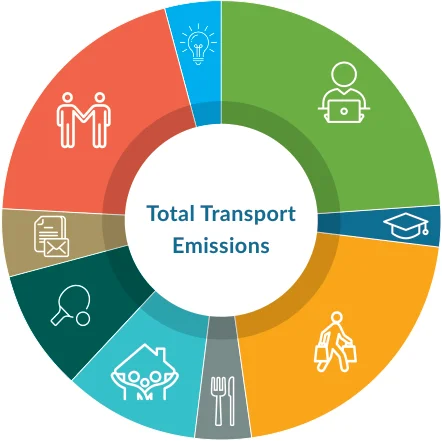
Figure 4: Why we travel
We also have an ageing and diverse population. Along with supporting the NPF growth targets, we must ensure that sustainable mobility options meet the needs of all sectors of our society and are accessible to everyone regardless of ability, age, ethnicity, gender, income and sexuality.
Total Transport
Emissions
Pages 14–15 · View in original PDF