National Sustainable Mobility Forum
The establishment of a National Sustainable Mobility Forum as a means of providing a platform for collaborative engagement with national, regional and local stakeholders was one of the core actions set out on the SMP. The inaugural Forum took place in April 2023, and the second was held in Portlaoise on 23 May 2024.
change required for transport, in the form of youth participants and panellists from community organisations around the country.
The 2024 Forum was framed around the themes of Policy, Vision, and Practice. The first of these sessions was coordinated by Technological University Dublin and brought together national and international academics to consider the SMP from a variety of lenses, such as social integration, urban planning and health. In the second session, a panel of youth representatives drawn from the National Youth Assembly on Climate and participating delegates from the Transport Research Arena conference explored utopian and dystopian scenarios of how sustainable mobility could evolve between now and 2050, putting forward practical solutions to address the pressing transport issues of our time. The
This year’s Forum was focused on reviewing the effectiveness of the SMP, considering how our transport system will need to develop to meet our future needs, and reflecting on the behavioural and societal changes needed to realise our emissions reduction targets of 50% by 2030 and climate neutrality by 2050. This year, in light of 2024 being designated the ‘Year of Engagement’ on climate action, a particular focus was placed on those groups most likely to be impacted by the systemic
Figure from page 16
third and final session heard from community representatives who are putting sustainable mobility projects into practice in their local communities and illustrated how behavioural change can be generated at a local level.
platform for sustainable mobility practitioners to share learnings and to access key information on funding, research, latest news and training as well as a large reservoir of usecases in the area.
A new Sustainable Mobility Academy was also launched at the Forum. This is an online
A report of the Forum has been published and is available to access here.
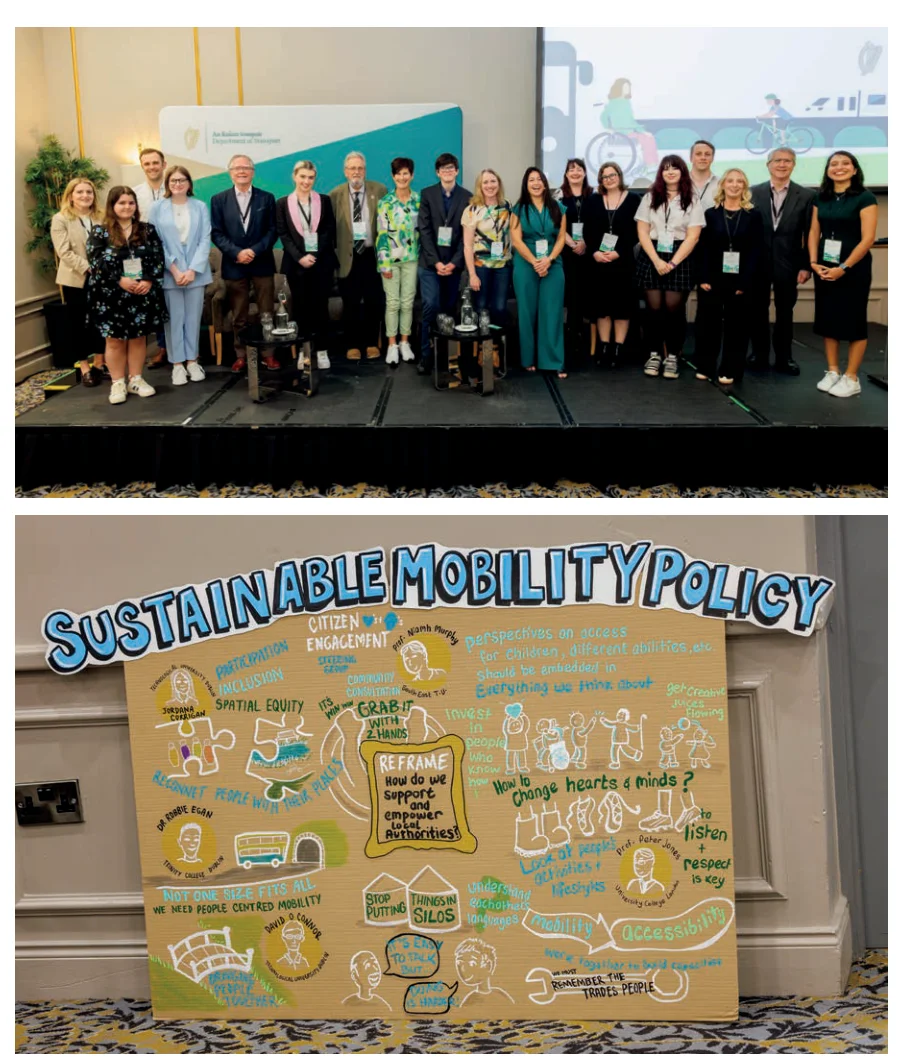
Figure from page 17
Moving Together: A Strategic Approach to the Improved Efficiency of the Transport System in Ireland
As per Action 39 of the SMP, which committed to establishing ‘a Demand Management Unit within the Department of Transport to develop an approach to traffic demand management taking account of the recommendations of the Five Cities Demand Management Study’ and a later commitment in CAP23 to develop a new national demand management strategy, the Department published for public consultation a draft Strategy ‘Moving together - A Strategic Approach to Improving the Efficiency of Ireland’s Transport System’ in April 2024.
transport service enhancements in urban and rural areas, new active travel infrastructure, and the Safe Routes to Schools Programme. In this way, it can unlock the full potential of the Government’s investment in sustainable mobility options as envisaged by the SMP.
To guide the development of Moving Together, a Steering Group was established in May 2023. Six subgroups were also established to guide thinking on key areas of focus. The work of these subgroups, which comprised over 100 stakeholders from 57 organisations, informed the draft Strategy and is reflected in six separate reports that were published alongside the draft Strategy and Implementation Plan (IP) as part of a public consultation process that was held between April and August 2024. As part of this process, the Department also intends carrying out further targeted stakeholder engagement before submitting the draft Strategy and IP to Government for approval by the end of 2024.
This draft strategy is intended to be a call for collective action across Government and society not only to help reduce carbon emissions from transport over the medium to long term, but also to address the more immediate issues of congestion, road safety and air quality. Moving Together also seeks to support a Just Transition by encouraging the alignment of demand management measures with other planned measures, such as public
Figure from page 18
Case Study | Dún Laoghaire-Rathdown Public Realm and Coastal Mobility Route
Over the last few years, Dun Laoghaire Rathdown County Council (DLRCC) have introduced a series of “Living Streets” initiatives including segregated cycleways, public realm design, and reconfigured vehicle circulation to support pedestrians and cyclists in the area of Dun Laoghaire as well as Blackrock. In essence, this approach is introducing a 10-minute town model. A key part of the Living Streets case study is the 4.5km coastal mobility route (CMR), which links five villages along the South Dublin coast between Blackrock to Sandycove.
economic impact, businesses interviewed along the CMR were largely positive regarding its economic impact and accepted or supported its ongoing presence. Several businesses noted an increase in footfall.
The Blackrock main street redesign also had significant stakeholder support with 84% and 72% of surveyed residents and businesses, respectively, confirming that the new layout is a good addition.
Several lessons were learned from implementing the schemes in Blackrock and Dun Laoghaire, including the value of tactical urbanism or pilots to illustrate the benefits of a scheme. Other important learnings from the projects were the importance of using language that highlights the benefits to the community, engaging regularly with a broad range of people and representative bodies such as disability groups, and having strong input and buyin from resident or business communities. Collectively, these inputs ensured that the principles of accessibility and inclusion were central to delivery of the projects.
Through collaboration between DLRCC and Technological University (TU) Dublin, an evaluation framework was developed to define what types of data needed to be collected for monitoring and analysis. The independent evaluation of the CMR by TU Dublin found that the route demonstrated positive impacts both in terms of mobility and from a socio-economic perspective. It is the highest performing cycle route in the DLR area, with bike trips increasing through the provision of quality cycle infrastructure. In terms of business and
Pages 16–19 · View in original PDF