3.9 Movement of Goods and Services
3.9 Movement of Goods and Services
On National Roads a balance must be found between the movement of people and the movement of goods.
Ireland’s economy is heavily dependent on the efficient movement of goods, both domestically as well as into and out of the country and is therefore dependent on efficient domestic and international transport networks. Freight dependent industries need high-quality transport connections to ensure certainty of arrival of incoming goods and outward shipping of products. Producers and retailers need efficient distribution systems for timely access to their markets and customers.
Currently, the vast majority of internal trade freight in Ireland is carried on the road network14, in a variety of vehicles, from Heavy Goods Vehicles (HGVs) to smaller vans TII estimates that in the region of 80-90 percent of all freight transport occurs on National Roads15. The movement of goods takes place throughout the entire country, and intensifies on National Primary roads, notably on the east coast, M50, and around Cork and Limerick, as illustrated in Figure 3.5. Along the M50, for example, goods vehicles (HGV/LGV) represent 25 percent of all vehicles and take up 33 percent of the available road space.
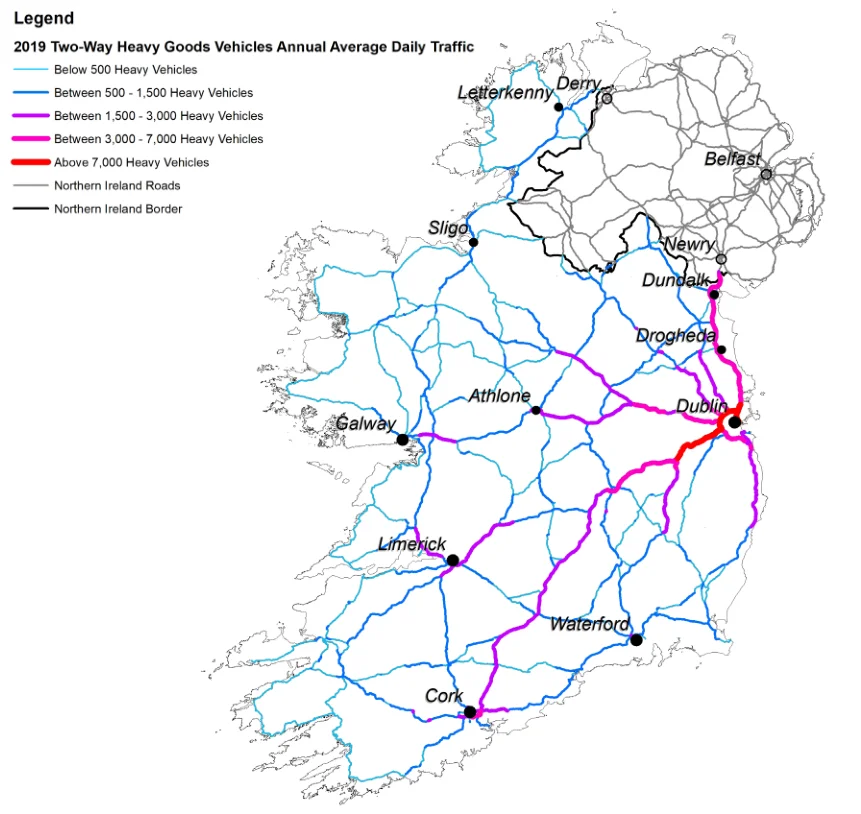
Figure 3.5 National weekday HGV movements, 2019
14 Central Statistics Office, Road Freight Transport Survey Quarter 4 and Year 2020. 15 Vehicle kilometers estimate based on CSO national freight travel estimates and TII’s network of roadside traffic counters.
There is often limited flexibility in mode or time of travel associated with freight transport given its role in the movement of essential goods for society. The importance of facilitating efficient freight transport for society was highlighted during the COVID pandemic where, despite restrictions to movement of people, demand for goods movement remained constant – only 4 percent less in 2020 than 201916.
Transport emissions reduction from goods vehicles represent a significant challenge, as, reflective of their size/engine types, they generate 5 to 6 times higher emissions than cars. In 2020, goods vehicles represented nearly 40 percent of the total CO2e emissions on National Roads17. While the car fleet is transitioning towards EV/LEVs there are currently no scaled alternatives for HGVs, though the Alternative Fuels Infrastructure Regulation is expected to place an emphasis on provision of electric vehicle charging for HGVs. The progression of technology and traffic management measures is therefore necessary..
Integration of road and rail freight is supported by TII and is important for reducing freight related congestion and emissions on the National Roads network. Iarnród Éireann has developed its strategy Rail Freight 2040, which envisions rail playing a key role in enhancing regional connectivity and supporting economic growth whilst meeting climate change objectives.
National Roads can be essential arteries for economic activity across the country, their role in this regard must be acknowledged and protected. National Roads infrastructure should be fit for purpose for the transport of heavy vehicles, noting the high levels of wear and degradation of the carriageway under heavy loading. While the freight sector has proven to be historically resilient, capacity re-allocation or freight specific transport management schemes, which would need to be considered at the appropriate tier of the NIFTI Modal and Intervention Hierarchies. In December 2022, the DoT published ‘Ireland’s Road Haulage Strategy 2022–2031’. When implementing NR2040, TII will work closely with the DoT to take account of the needs of the Haulage and Road Freight sector.
Pages 29–30 · View in original PDF