Process to Develop the Strategy
Process to Develop the Strategy
The key policies underpinning the development of this Strategy are the SMP (2022) and the Climate Action Plan 2023. The SMP committed to developing an approach to traffic demand management, taking account of the recommendations of the Five Cities Demand Management Study, while the Climate Action Plan 2023 committed to developing this Strategy.
The Strategy does not provide consent or establish a framework for granting consent and will not be binding on any decisions relating to the granting of consent. The Strategy is situated alongside statutory documents that form the framework for future development consent of projects and are subject to requirements relating to environmental assessment/screening for environmental assessment, as appropriate.
At the outset, reflecting the system-wide changes required to deliver an effective strategy, the Department of Transport undertook an initial engagement with stakeholders on demand management at the department’s National Sustainable Mobility Stakeholder Forum in September 2023 and the National Climate Stakeholder Forum led by the Department of Energy, Climate and Communications (DECC) in May 2023.
In order to be realised, transport related plans and projects (in a similar way to other plans and projects from any other sector) will have to comply, as relevant, with various legislation, policies, plans and programmes (including requirements for lower-tier Strategic Flood Risk Assessment, Strategic Environmental Assessment, Appropriate Assessment and Environmental Impact Assessment and other licensing requirements as appropriate) that form the statutory decision-making and consent-granting framework.
Recognising the need for a whole of Government approach, a National Demand Management Steering Group was established in May 2023 consisting of the members as shown below.
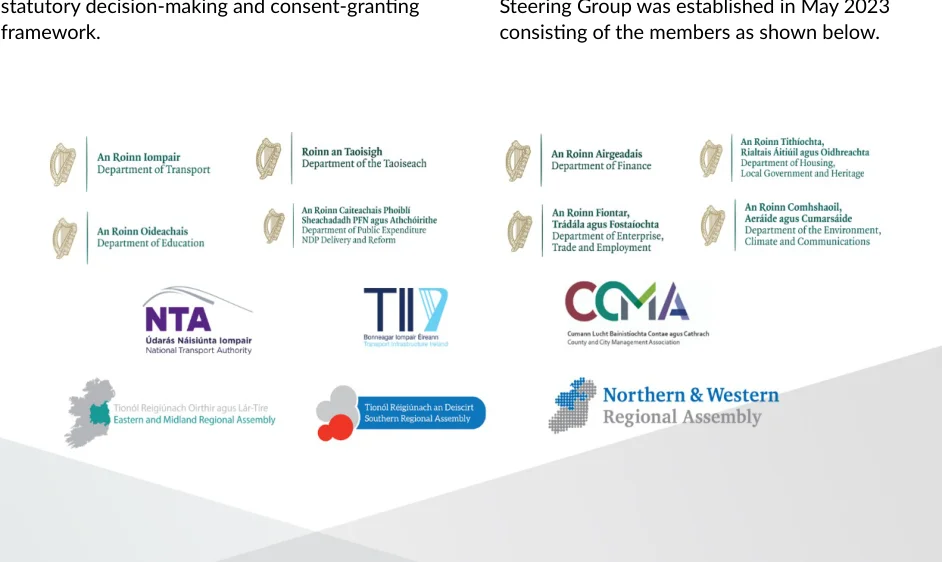
Figure 2: Steering Group Members
At the outset, six key areas for consideration were identified, with a system, demand generation and just transition focus. These were as follows (more detail on the rationale for these areas is set out in Chapter 9):
(NWRA) and local authorities, NGOs (e.g. Irish Doctors for the Environment, An Taisce); disability representatives; community groups e.g. Dingle Hub; Transport Operators (Iarnród Éireann, Bus Éireann); academia (Trinity, Technological University Dublin, University of Limerick, Atlantic Technological University Sligo, University College London); industry/business - Freight Transport Association of Ireland (FTAI), Irish Road Haulage Association (IRHA), Ports, Amazon, Irish Business and Employers Confederation (IBEC); and media representatives among others.
Pages 23–24 · View in original PDF