12.1 Determination of vessel's stability by means of rolling period tests
12.1Determination of vessel’s stability by means of rolling period tests .1The International Maritime Organization (IMO), recognizing the desirability of supplying to
masters of small vessels instructions for a simplified determination of initial stability, developed a standard for the performance of rolling period tests. It was concluded that the rolling period test was a useful means of approximately determining the initial stability of small vessels when it is not practicable to give approved loading conditions or other stability information, or as a supplement to such information. Accordingly, the IMO incorporated this guidance in Annex 3 (previously section 7.6) of the Code on intact stability for all types of ships covered by IMO instruments (1993). The following duplicates this guidance in a form appropriate to small fishing vessels. .2Investigations comprising the evaluation of a number of inclining and rolling tests according
to various formulae showed that the following formula gave the best results and has the advantage of being the simplest:
2
f B GM
o T r
where: f factor for the rolling period (rolling coefficient) as given in paragraph 4;
B breadth of the vessel in metres;
Tr time for a full rolling period in seconds (i.e. for one oscillation “to and from” port - starboard - port, or vice versa).
.3The factor f is of the greatest importance and the data from the above tests were used for
assessing the influence of the distribution of the various masses in the whole body of the loaded vessel. .4For fishing vessels, the following average values were observed:
| f values (approximate)* | |
|---|---|
| Double-boom shrimp fishing boats Deep-sea fishing boats Boats with a live fish well | 0.95 0.80 0.60 |
- The stated values are mean values. Generally, f values observed during the tests were within ± 0.05 of those given above. .5It should be noted that the greater the distance of masses from the rolling axis, the greater
the rolling coefficient will be. Therefore, it can be expected that:
a.the rolling coefficient for an unloaded vessel will be higher than that for a loaded
vessel; and
b.the rolling coefficient for a vessel carrying a great amount of bunkers and ballast -
both groups are usually located in the double bottom, i.e. far away from the rolling axis - will be higher than that of the same vessel having an empty double bottom. .6The above recommended rolling coefficients were determined by tests with vessels in port
and with their consumable liquids at normal working levels; thus, the influences exerted by the vicinity of the quay, the limited depth of water and the free surfaces of liquids in service tanks are included. .7Experiments have shown that the results of the rolling test method get increasingly less
reliable the nearer they approach GM values of 0.20 m and below. .8For the following reasons, it is not generally recommended that results be obtained from
rolling oscillations taken in a seaway:
a.exact coefficients for tests in open waters are not available;
b.the rolling periods observed may not be free oscillations but forced oscillations due
to the seaway;
c.frequently, oscillations are either irregular or only regular for too short an interval of
time to allow accurate measurements to be observed; and
d.specialised recording equipment is necessary. .9However, sometimes it may be desirable to use the vessel’s period of roll as a means of
approximately judging the stability at sea. If this is done, care should be taken to discard readings, which depart appreciably from the majority of other observations. Forced oscillations corresponding to the sea period and differing from the natural period at which the vessel seems to move should be disregarded. In order to obtain satisfactory results, it may be necessary to select intervals when the sea action is least violent and it may be necessary to discard a considerable number of observations. .10In view of the foregoing circumstances, it needs to be recognized that the determination of
the stability by means of the rolling test in a seaway should only be regarded as a very approximate estimation. .11The determination of the stability can be simplified by giving the master permissible rolling
periods, in relation to the draughts, for the appropriate value(s) of f considered necessary. .12The initial stability may also be more easily determined graphically by using the sample
nomogram (fig.1) as described below:
a.The values for B and f are marked in the relevant scales and connected by a straight
line (1). This straight line intersects the vertical line mm at the point M.
b.A second straight line (2) which connects this point M and the point on the Tr scale
corresponding with the determined rolling period intersects the GM scale at the requested value.
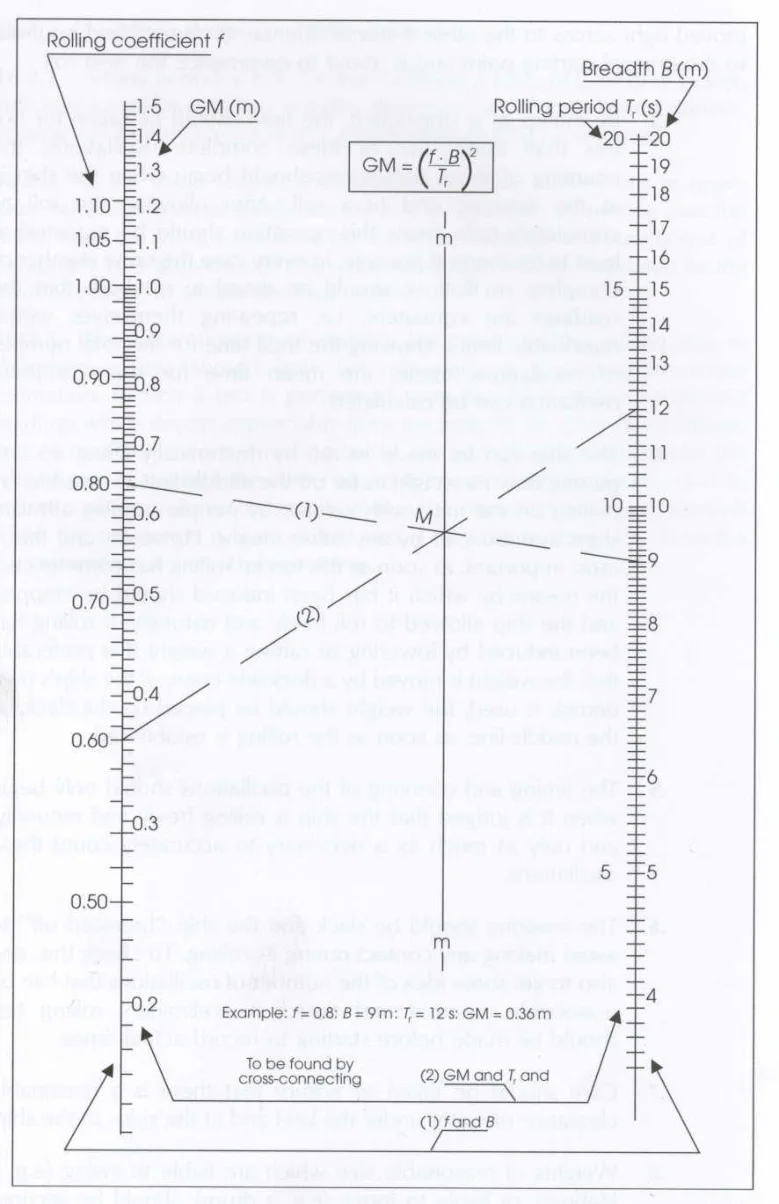
Fig.1
12.2Recommendations on procedures for the conduct of rolling tests
12.2.1 The rolling period required is the time for one complete oscillation of the vessel and to ensure the most accurate results in obtaining this value the following precautions should be observed.
.1The test should be conducted with the vessel in harbour, in smooth water with the minimum
interference from the wind and tide. .2Starting with the vessel at the extreme end of a roll to one side (say port) and the vessel about
to move towards the upright, one complete oscillation will have been made when the vessel has moved right across to the other extreme side (i.e. starboard) and returned to the original starting point and is about to commence the next roll. .3By means of a stop-watch, the time should be taken for not less than about five complete
oscillations. Counting of the oscillations should begin when the vessel is at the extreme end of a roll. After allowing the roll to completely fade away, this operation should be repeated at least twice more. If possible, in every case the same number of complete oscillations should be timed to establish that the readings are consistent, i.e. repeating themselves within reasonable limits. Knowing the total time for the total number of oscillations made, the mean time for one complete oscillation can be calculated. .4The vessel can be made to roll by rhythmically lifting up and putting down a weight as far off
the centreline as possible; by pulling on the mast with a rope; by people running athwartships in unison; or by any other means. However, and this is most important, as soon as this forced rolling has commenced, the means by which it has been induced should be stopped and the vessel allowed to roll freely and naturally. If rolling has been induced by lowering or raising a weight it is preferable that the weight is moved by a dockside crane. If the vessel’s own derrick is used, the weight should be placed on the deck, at the centreline, as soon as the rolling is established. .5The timing and counting of the oscillations should only begin when it is judged that the vessel
is rolling freely and naturally, and only as much as is necessary to accurately count these oscillations. .6The mooring should be slack and the vessel breasted off to avoid making any contact with the
wharf or any other structure during its rolling. To check this, and to get some idea of the number of oscillations that can be reasonably counted and timed, a preliminary rolling test should be made before starting to record actual times. .7Care should be taken to ensure that there is a reasonable clearance of water under the keel
and at the sides of the vessel. .8Weights of reasonable size which are liable to swing (e.g. a lifeboat), or liable to move (e.g. a
drum), should be secured against such movement. The free surface effects of slack tanks should be kept as small as is practicable during the test.
12.2.2 Limitations on the use of this method
.1A long period of roll, corresponding to a GMo of 0.20 m or below, indicates a condition of low
stability. However, under such circumstances, accuracy in determination of the actual value of GMo is reduced. .2If, for some reason, these rolling tests are carried out in open, deep but smooth waters,
inducing the roll, for example, by putting over the helm, then the GMo calculated by using the method and coefficient of paragraph 1 above should be reduced by a figure to be estimated by the Administration to obtain the final answer. .3The determination of stability by means of the rolling test in disturbed waters should only be
regarded as a very approximate estimation. If such a test is performed, care should be taken to discard readings, which depart appreciably from the majority of other observations. Forced oscillations corresponding to the sea period and differing from the natural period at which the vessel seems to move should be disregarded. In order to obtain satisfactory results, it may be necessary to select intervals when the sea action is least violent and it may be necessary to discard a considerable number of observations.
ANNEX 2 – STABILITY GUIDANCE NOTES FOR VESSEL OPERATORS
Applies to all fishing vessels (Pre-2004 and Post-2004)
(Referred to in Chapters 2, 3, 4, 6 and 11)
Pages 60–65 · View in original PDF