6 Industry
Text from pages 18, 19, 20, 21 of the source PDF is machine-read (OCR) from a scanned image and may contain recognition errors.
6Industry
In 2024, Industrial emissions accounted for 10.9% of Ireland’s total emissions.
Manufacturing combustion and industrial processes are the key emission sources.
Industry emissions are largely affected by cement production in Ireland, which in turn
can be impacted by economic cycles.
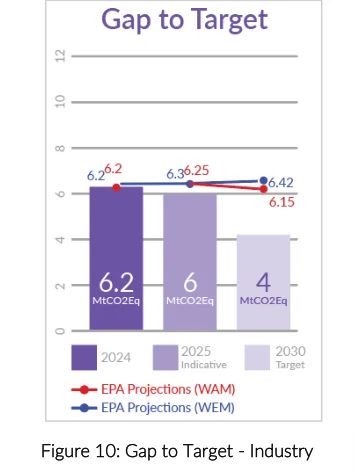
Figure from page 17
| Figure 9: Industry sector emissions share in 2024 |
2 new Industry Actions were due for
completion in Q4, of which 1 was completed
on time: Publish annual spending by enterprise
agencies on client decarbonisation projects
under Environmental Aid Programme and
Green Transition Fund. The spending details
can be found in this report’s Annex of
Actions.

Figure from page 17
Greening Industry
65.6% 63.8% 63.7% 2022 2023 2024
==2025 Target =—=Progress
No new high impact reportable actions for delivery this quarter
No new high impact reportable actions for delivery this quarter
g Examining options that may incentivise electrification of heat
@ Propose tax measures to incentivise the installation of energy efficient equipment
Publish annual spending by enterprise agencies on client iv) decarbonisation projects under Environmental Aid Programme and Green Transition Fund
‘X) Publish a report on work of the Carbon Capture Utilisation and Storage Taskforce
7 Land Use, Land Use Change and Forestry (LULUCF)
In 2024, Ireland’s emissions from land use were 4.5% of total emissions. The LULUCF
sector has been an emissions source in Ireland since 1990. It has a challenging future
profile for emissions generation due to the ageing profile of existing trees, continued low
planting rates and large areas of drained emissive peat soils used for farming, forestry
and peat extraction.
LULUCF Emissions
LULUCF 5%
|
|| Baseline Estimated 2030 target
=@= EPA Projections (WAM) =e EPA Projections (WEM)
Figure 11: LULUCF sector emissions share in 2024
Figure 12: Expected LULUCF Emissions
Two new LULUCF Actions were completed in Q4 on time, Undertake formal midterm review of the Forestry Programme 2023-2027 (see case study) and Publish Coillte’s Land- Use Strategic Implementation Plan, available
target and Publish report of Phase 2 of the Land Use Review. Neither Action was
completed in Q4.
here.)
By the end of Q4 2025, 2,527 hectares of forest had been planted over the year, well below the CAP25 target of 8,000 hectares
There were 2 delayed CAP25 LULUCF Actions: Review progress towards 2030 KPI of an additional 30,000 ha of _ peatland
to be planted annually.
rehabilitation and explore potential to increase
Changing Our Land Use
10,000 8,000 8,000 8 6,000 8 ° @ 4,000 2,527 5 000 1,652 1,573 0
Legacy Actions
Review proposed Teagasc MACC measures to determine which actions are possible to deliver sustainably across all land use types and provide a detailed mapping exercise to achieve the EU LULUCF regulation target
g Completed on Time
VY) Completed subsequently delivery this quarter
x) Delayed
The Forestry Programme for the period 2023-2027 aims to encourage a substantial increase in afforestation by offering attractive and diverse options for planting to support our national target of 8,000 hectares of new forests per year. It also provides for a range of schemes to support the maintenance and sustainable management of existing forests.
In 2025, Department of Agriculture, Food and the Marine (DAFM) has undertaken a Mid-Term Review (MTR) of the Forestry Programme in conjunction with members of the Forest Strategy Consultative Committee (FSCC), which represents a broad range of Forestry stakeholders. The existing measures and schemes were reviewed with a view to improving their performance for the remainder of the Forestry Programme 2023-2027 term, to help fulfil our existing forestry policy objectives. The European Commission have been notified of proposed changes.
The proposed outcomes from this Mid-Term review are required to be screened, to determine if they would have any significant effects on the environment. DAFM has accordingly issued a notice of screening to the prescribed statutory authorities.
In addition, following Storms Eowyn and Darragh, significant damage was caused to both Coillte and privately owned forests. This has necessitated substantial re-planning of forest operations over the short and medium in the forest sector as it aims to recover the windblown timber. DAFM has established a Forest Windblow Taskforce which comprises of stakeholders representing forest owners, forestry companies, Teagasc and Coillte. It is meeting regularly to work collaboratively and is focusing on providing practical solutions immediately to those landowners whose forests have been adversely affected and are faced with a major clean-up operation in dealing with fallen trees.
Satellite imagery assessments are indicating that just over 26,000 hectares of forestry have been damaged by windblow, including approximately 13,000 in private ownership. Government approval has now been received to launch a new €55 million Reconstitution Scheme for qualifying private forest owners. The Scheme will provide support to private forest owners for replanting their damaged forest areas. This Scheme is in alignment with the Forestry Programme 2023-2027, which contains a general Reconstitution measure that aims to restore and retain forest land and forest ecosystems following significant damage events. Development of this Scheme is underway, and it is expected that applications for the scheme will open in early 2026.
Pages 17–21 · View in original PDF