5 Buildings
In total, 11% of Ireland’s emissions in 2023 (including LULUCF) came from Buildings
(mostly residential buildings) and the provisional emissions for 2024 are at 10.4%. Ireland
is progressing with a major transformation of its building stock, including plans to retrofit
500,000 homes by 2030, roll out large-scale district heating in densely populated urban
areas, and enhance energy performance standards for commercial buildings.
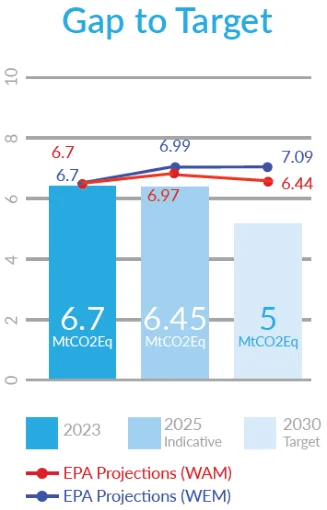
Figure 8: Gap to Target - Buildings
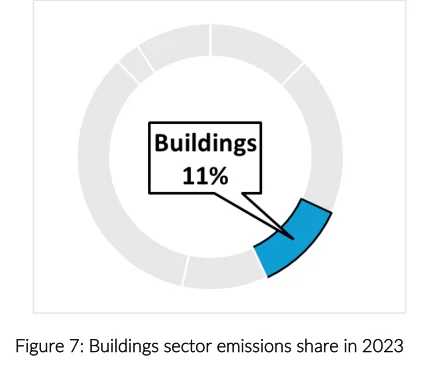
Figure from page 17
Figure 7: Buildings sector emissions share in 2023
The provisional emissions for 2024 indicate that
emissions from the Residential sector amounted
to 5.61 million tonnes of CO₂ equivalent (Mt
CO₂eq), representing an increase of 4.9% (0.26
Mt CO₂eq) compared to 2023.
scenarios, respectively.
Ireland’s Final Greenhouse Gas Emissions 2023
Actions due for completion in Q2 and Q3
highlight reductions in emissions driven by high
focused on key strategies to reduce emissions,
fuel prices, regulation, and a milder winter. Coal
such as improving building standards and
use reduced by 22%, peat by 13%, oil by 0.3%
decarbonising public sector building stock. A
and natural gas by 14%. EPA projections indicate
report on an embodied carbon methodology and
that the sector will emit between 6.4 to 7.1 Mt
structures to reduce carbon in construction
CO2 eq. by 2030 under WAM and WEM
materials was completed in Q3 (see annex).
In 2024, all fossil fuels used for household space
By the end of Q3, 76,871 retrofits to B2 were
and water heating saw increases except peat,
completed, achieving 64% of the 2025 target.
which decreased by 8.6%. Coal usage rose by
Additionally, 17,324 heat pumps were installed,
6.6%, kerosene by 8.5% and natural gas by 3.3%.
with a target of 45,000 by 2025.

Figure from page 17
Page 17 · View in original PDF