6 Industry
Text from page 20 of the source PDF is machine-read (OCR) from a scanned image and may contain recognition errors.
6Industry
Industrial emissions accounted for 11% of Ireland’s total emissions in 2023 (including
LULUCF). Manufacturing combustion and industrial processes are the key emissions
sources. Industry emissions are largely affected by cement production in Ireland, which
in turn can be impacted by economic cycles.
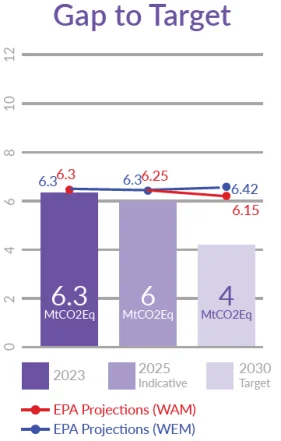
Figure 10: Gap to Target - Industry
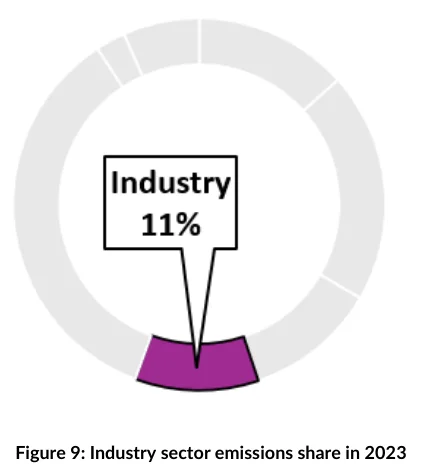
Figure from page 19
Figure 9: Industry sector emissions share in 2023 Figure 10: Gap to Target - Industry
This trend in reductions will have to
In this sector, most emissions come from
accelerate significantly to stay within the
burning fuels for manufacturing processes,
sector’s emissions ceiling as EPA
followed by process-related emissions from
projections suggest that industry emissions
industries such as mineral, chemical, and
will remain relatively consistent out to
metal production.
CAP25 notes that emissions from the
Actions in 2025 will focus on cement and
industry sector decreased by 9.5% between
construction decarbonisation, carbon-
2018 and 2023, driven by switching to
neutral heating in Industry, and
lower carbon fuels and investment in
encouraging more efficient use of energy.
decarbonisation by some of Ireland’s
largest industrial emitters.

Figure from page 19
@) Greening Industry
Key Performance Indicators / 2025 Targets
Conduct feasibility assessment on carbon x] capture storage ><] Publish the implemention plan for the National Hydrogen Strategy
@ Completed on Time @ Completed subsequently
a Delayed
Pages 19–20 · View in original PDF