3 Transport
3 Transport
In 2023, Transport was responsible for 20% of total greenhouse gas emissions in Ireland
(inclusive of LULUCF). The emissions from this sector are the second biggest (after
Agriculture) and have faced the largest increase of all sectors since 1990. As can be seen
in Figure 4, the measures implemented, and speed at which this takes place, will
determine the rate at which transport emissions decline by 2030 (between 9.7 and 11.2
Mt CO2 eq. according to EPA projections).
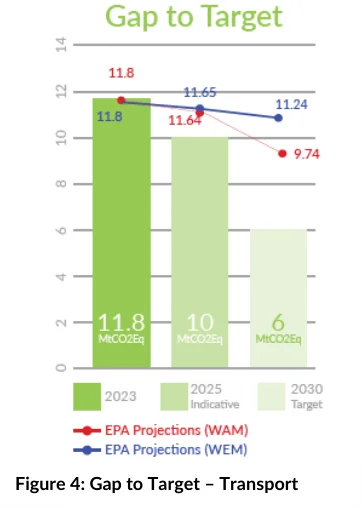
Figure from page 10
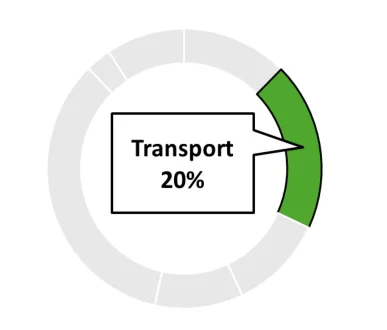
Figure 3: Transport sector emissions share in 2023
Figure 4: Gap to Target – Transport
Emissions in the transport sector increased by
In the medium term, fleet electrification and
0.3% in 2023, as a result of the rebound in
greater use of biofuels are expected to deliver
emissions since the Covid pandemic. To stay
the largest share of emissions reductions.
within the sector’s emissions ceiling, an
Ireland’s Final Greenhouse Gas Emissions in
exceptional 12.4% reduction in emissions will
2023 noted that 23% of new car registrations
now be needed in both 2024 and 2025.
were electric in 2023.
Key goals for cutting emissions include
Under EPA projections, the transport sector is
reducing total vehicle kilometres travelled by
expected to achieve a 9 - 21 % emissions
20% compared to business-as-usual, halving
reduction compared to 2018 levels by 2030
fuel consumption, and significantly increasing
under WEM and WAM scenarios
the number and share of trips made by
respectively.
sustainable transport modes.

Figure from page 10
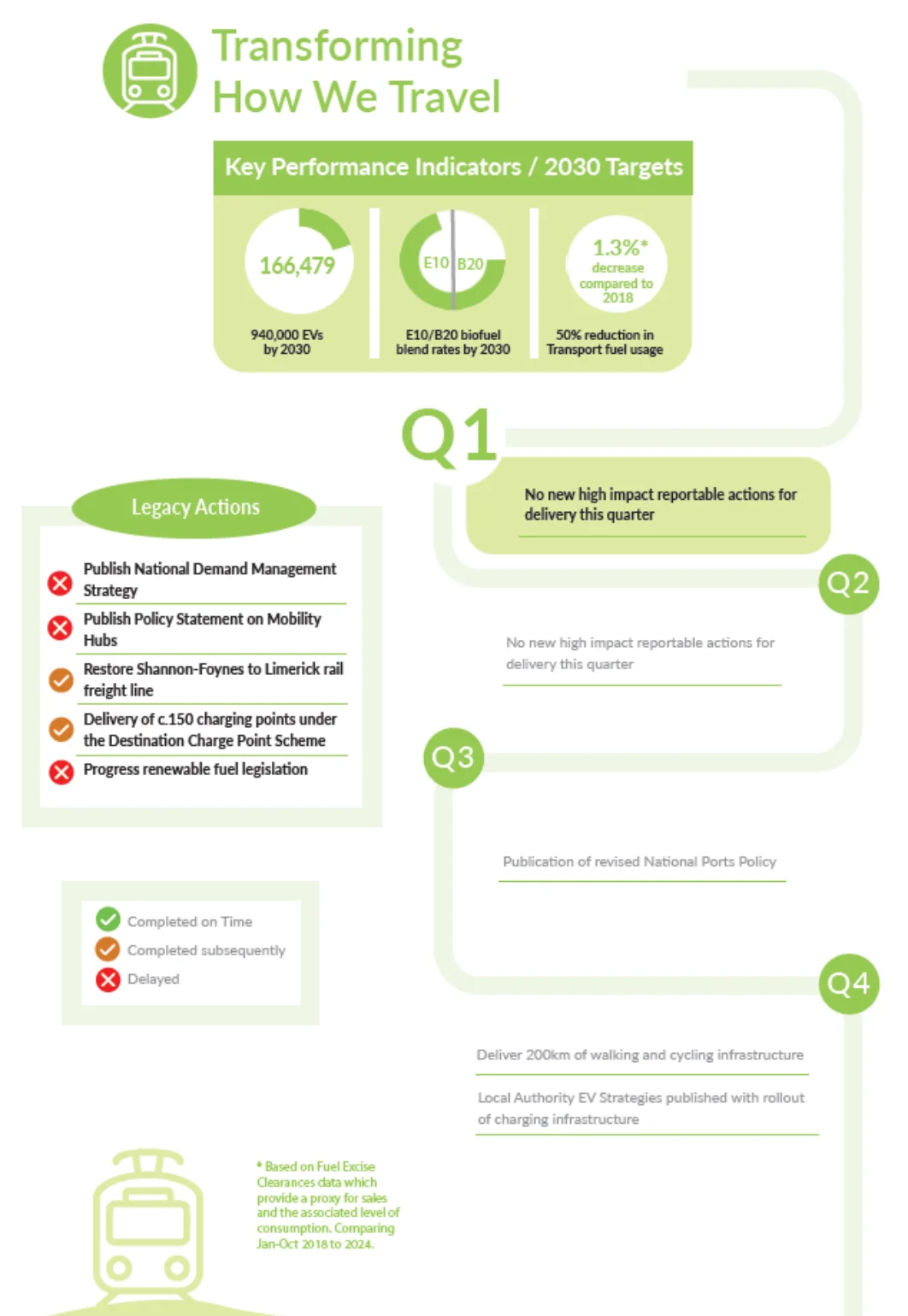
Figure from page 11
| Completed CAP24 Action TR/24/21 | ||
|---|---|---|
| Ongoing delivery of Destination Charge Point Scheme – including sports clubs and | ||
| community facilities | ||
| The commitment to assisting the population in switching to Electric Vehicles and more sustainable travel options brings us closer to meeting our national carbon reduction goals. Under Action TR/24/21, support has been provided to over 200 eligible sites via funding and the development of an updated delivery mechanism for the roll out of publicly accessible charging points across the island. While most EV charging takes place at home, the Destination Charge Point Scheme helps to provide charging facilities for those without such access at home, and for those looking to charge their EV while they are out. The Shared Island Sports Club EV Charging Scheme opened in January 2023. Through the Shared Island Fund, this scheme provides grant funding for local sports clubs across the island to roll-out a series of public EV charging points. Site inspection consultants assessed 248 sites with a final list of 229 eligible sites published. Of the 229 eligible sites 181 are in the South and 48 in Northern Ireland. A new mechanism for delivery is needed entailing the procurement of a framework of Charge Point Operators (CPOs). This is currently being evaluated, and appointments will be made to the panel in June 2025. The EU Just Transition Fund Community Facilities EV Charging Scheme also provides funding to support the installation of public EV charging infrastructure at community facilities, such as libraries, community centres and public health centres within the Just Transition territory. Of the 193 applicants to this scheme, 93 sites were deemed eligible for technical site inspection. The site inspection process has been procured with contracts now awarded. The technical site assessments commenced this quarter and are now 70% completed. |

Figure from page 12
Pages 10–12 · View in original PDF