5.7 Benefits for Ireland
5.7 Benefits for Ireland
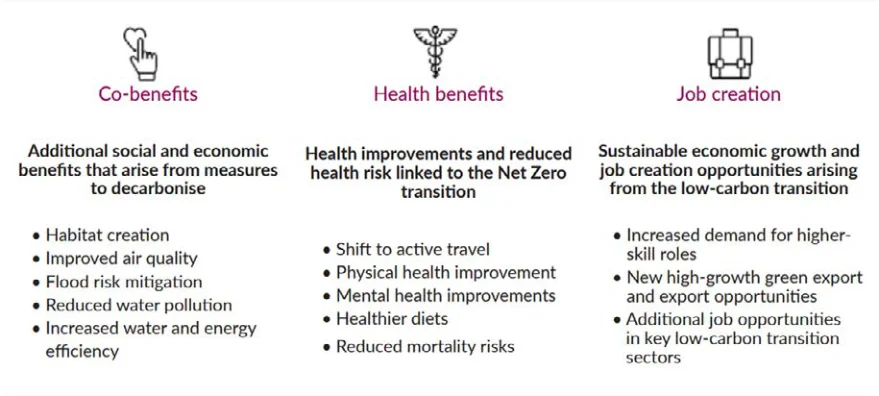
Figure 5.4 – Benefits of climate action
Co-benefits: Climate co-benefits refer to additional social and economic benefits that arise from climate action. For example, the restoration of peatlands and increase in woodland enables habitat creation and improves air quality. Increased forest cover can retain excess water and mitigate the impacts of floods, increasing resilience to climate change. Changes to farming practices bring air quality improvements from the reduction in ammonia use, and reduced eutrophication/water pollution because of more efficient nitrous oxide application. Regenerative agricultural practices improve soil health and the soil’s capacity to infiltrate, reducing the need for irrigation and improving water and energy efficiency.
Health benefits: There is a wealth of evidence that many climate actions can lead to health improvements and reduced health risks. For example, embracing active travel (walking and cycling) can have improved physical and mental health benefits which, considered in economic terms, are even greater than the positive environmental impact, while the shift to renewable fuel sources improves air quality. Additionally, climate action can help improve air quality, which was highlighted as a priority in the EPA’s 2022 Air Quality in Ireland report.35 Action to reduce transport emissions in particular reduces exposure to pollutants and associated mortality risks and will help Ireland achieve its ambition to move towards the World Health Organisation Air Quality guidelines, as outlined in the Clean Air Strategy.
Job creation: Climate action can lead to market opportunities that enable sustainable economic growth and green job creation. For example, increased demand for jobs in higher- skilled roles such as offshore wind installation engineers. Ireland is well positioned to seize new high-growth green export and import substitution opportunities such as horticulture and harvested wood products. Further opportunities for job creation exist in low-carbon transition sectors such as buildings, transport, and manufacturing. In the buildings sector, this could include jobs to support the energy efficiency and low-carbon heat programmes.
The actions set out in this plan aim to ensure that Ireland’s response to climate change maximises the potential benefits outlined above and ensures that the impacts are distributed fairly.
Pages 71–72 · View in original PDF