14.1 State of Play
14.1 State of Play
The built environment comprises the residential, public and commercial sectors, and accounted for 11.1% of Ireland’s greenhouse gases (GHG) in 2022, down from 12.3% 2021.83 The Sustainable Energy Authority of Ireland’s (SEAI) Energy in Ireland 2022 report84 indicates that fossil fuels remain the dominant source of energy in our homes, providing 72.6% of energy used in the residential sector in 2021. Oil and gas are used predominantly for space heating, but also for water heating.
Our building stock and heating requirements span all areas of our economy and society. This means that decarbonising our existing built environment will take an incredible effort across households, businesses and the public sector, supported by appropriate Government regulation and incentives. For this reason, the Heat and Built Environment Task Force has a key role in co-ordinating all the required actions. These actions are complex and take time, with long-term policy, legislative and funding clarity demanded by stakeholders as they consider significant investment decisions.
In addition to decreased emissions, a move away from imported fossil fuels towards indigenous renewables will increase our energy security. Sustained action to decarbonise heating will also help to address increased energy costs being experienced by householders and businesses. However, given the extent of the multi-annual investment in fossil fuel networks and supply chains, the transition requires State leadership, direction, and appropriate regulation and investment. In particular, affordability can be a significant challenge for homeowners seeking to upgrade their homes to a BER B2 rating with a heat pump.
As indicated in the Climate Conversations 2022 report85, Irish people have already taken action to reduce the amount of energy they use at home by a combination of means, including improving home insulation, using smart technology and installing heat pumps.
Energy efficiency first is the key principle in relation to the built environment and is included in the 2023 Energy Efficiency Directive for the first time as a policy requirement. The first goal should be to shrink our overall energy demand, through energy efficiency measures, which also makes our other energy and climate goals easier to achieve.
83 https://www.epa.ie/publications/monitoring—assessment/climate-change/air-emissions/irelandsprovisional-greenhouse-gas-emissions-1990-2022.php 84 Energy-in-Ireland-2022.pdf (seai.ie) 85 https://www.gov.ie/en/publication/bb1a3-climate-conversations/ https://www.gov.ie/en/publication/ bb1a3-climate-conversations/
14.1.1 Stocktake of Abatement Progress to Date and Corrective Actions Required
Based on the EPA’s 2023 emissions projections, both the residential and commercial/public sub-sectors are projected to marginally exceed their sectoral emissions ceilings in the first carbon budget period. This is on the basis of all existing measures being delivered on time and in full. An exceedance is also projected for the second carbon budget period for the commercial/public sub-sector, with the residential sub-sector being marginally under its sectoral emissions ceiling for the period.86 This is a continuation of the progress already made by the residential sector and is described in section 14.1.2.
In its 2023 Annual Review, the Climate Change Advisory Council (CCAC) has indicated that 45% and 41% of the budgets for the residential and commercial/public sectors respectively were expended in the first two years of the first carbon budgetary period, and while these sectors are close to their target there is still potential for further emissions reduction measures to be taken.87 Given that the decrease in emissions in the built environment between 2021 and 2022 was partly due to increased fossil fuel prices and a mild winter, there is a risk that the abatement associated with fossil fuel price and supply effects may not be embedded in household heat demand over the longer term, and continued emphasis on long-term energy efficient behaviours and decarbonised technologies are key.
Figure 14.1 – Built Environment (Residential) Sector Emissions Relative to the Sectoral Emission Ceilings and EPA’s ‘WAM’ Scenario Projections88
FIGURE MAY NOT SUM DUE TO ROUNDING
WAM emissions Emissions remaining under SEC Emissions used under SEC
Built environment (Residential) SEC 2021-2025 and 2026-2030 and projected emissions in WAM scenario, MtCO2e
• The residential built environment sector has SECs of 29.3 and 23.5 Mt CO2e for periods 2021-25 and 2026-30 respectively
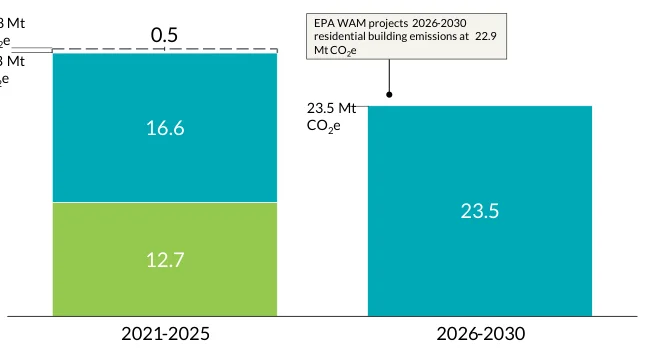
Figure from page 202
29.8 Mt CO2e
EPA WAM projects 2026-2030 residential building emissions at 22.9 Mt CO2e
0.5
29.3 Mt CO2e
• ~ 13 Mt CO2e of the residential built environment sector 2021- 2025 SEC were used in 2021-22, leaving ~17 Mt CO2e remaining for 2023-25
23.5 Mt CO2e
16.6
• EPA WAM projects residential built environment emissions to be 0.5 Mt CO2e above SEC for 2021 -25 and to meet the 2026 -2030 SEC
23.5
12.7
2021-2025 2026-2030
Sources: Climate Action Plan 2023 (Govt of Ireland, December 2022); Ireland’s Greenhouse Gas Emissions Projections (EPA, June 2023 .
86 https://www.epa.ie/publications/monitoring—assessment/climate-change/air-emissions/irelandsgreenhouse-gas-emissions-projections-2022-2040.php 87 CCAC-AR-2023-FINAL Compressed web.pdf (climatecouncil.ie) 88 A more detailed graphic regarding the Built environment (Residential) sector’s emissions relative to Sectoral Emission Ceilings and EPA projections is available in Appendix 1
Figure 14.2 –Built Environment (Commercial/Public) Sector Emissions Relative to the Sectoral Emission Ceilings and EPA’s ‘WAM’ Scenario Projections89
FIGURE MAY NOT SUM DUE TO ROUNDING
WAM emissions Emissions remaining under SEC Emissions used under SEC
Built environment (Commercial and Public) SEC 2021-2025 and 2026-2030 and projected emissions in WAM scenario, Mt CO2e
• The commercial and public built environment sector has SECs of ~7 and 5 Mt CO2e for periods 2021-25 and 2026-30 respectively
| EPA WAM projects 2026-2030 commercial and residential building | |
|---|---|
| emissions at 7.1 Mt CO2e |
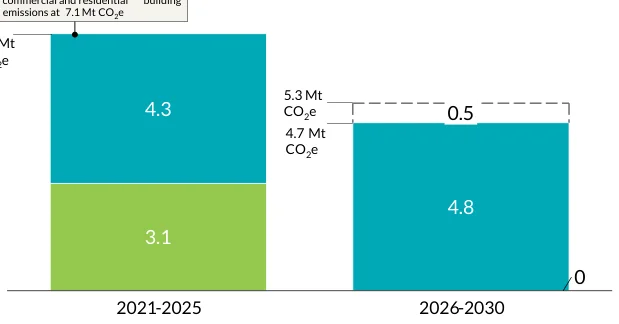
Figure from page 203
7.3 Mt CO2e
• ~ 3 Mt CO2e of the commercial and public built environment sector 2021-2025 SEC were used in 2021-22, leaving ~4 Mt CO2e remaining for 2023-25
5.3 Mt CO2e
4.3
| 0.5 | ||
|---|---|---|
| 4.8 |
4.7 Mt CO2e
• EPA WAM projects for commercial and public built environmental emissions to meet the 2021-25 to be ~0.5 Mt CO2e above the SEC for 2026-30
3.1
0
2021-2025
2026-2030
Source: DECC Climate Action Plan 2023, EPA: Ireland’s Greenhouse Gas Emissions Projections. June 2023.
In order to remain within the carbon budgets for both periods, all key metrics set out in Tables 14.5 and 14.6 must be met for the relevant carbon budget period. In line with the recommendations of the CCAC, this will require increased efforts to agree and implement relevant policies and measures, particularly in relation to areas still under policy development, such as district heating; biomethane production and end use; increased energy efficiency; and decarbonisation of the public sector estate. The Heat and Built Environment Delivery Taskforce will play a key role driving action in these areas for the coming year. The taskforce has already identified five cross-sectoral focus areas that need to be addressed to accelerate decarbonisation: policy/regulation, funding, communications, skills, and support delivery. Detailed planning and implementation at taskforce level is providing more granular detail on the implementation pathways and associated resource requirements at all levels of the economy and society.
89 A more detailed graphic regarding the Built Environment (Commercial and Public) sector’s emissions relative to Sectoral Emission Ceilings and EPA projections is available in Appendix 1
Progress on climate action in the built environment has been strong. For example, 27,199 residential property upgrades were completed in 2022, exceeding the target of 26,940, and in December 2022 the Tallaght District Heating Scheme became operational. Further details of progress can be found online in the Climate Action Plan 2023 (CAP23) Progress Reports90 and reports on residential retrofit91
Pages 201–204 · View in original PDF