8 Cross-cutting actions
Cross-cutting actions support the delivery of sectoral climate action through improvements in
governance, finance, planning, research, citizen engagement, circular economy, adaptation, and
public sector leadership. Diverse Departments and Agencies contribute to the completion of
such actions, providing a whole-of-Government response and enabling framework for national
climate action. Information on all cross-cutting actions due for reporting is at Appendix 1.
Amongst the cross-cutting activity pursued in
CAP24, promotion of the circular economy holds
potential to impact across key emissions-intensive
sectors (e.g. industry, agriculture, buildings etc), while
also reducing the emissions associated with waste in
Ireland.
According to this year’s Climate Change Advisory
Council (CCAC) sectoral review on Industry and
Waste, the most recent data indicate an increase in
waste emissions nationally. Methane from
decomposing waste in landfill is the main contributor
to emissions in the sector. The CCAC state that the
volume of waste being produced remains too high in
Ireland, with rates of reuse and recycling
considerably below the EU average.
Promoting a circular economy has become a priority
for Government policy. It aims to move away from
linear patterns of production and consumption that
focus on a ‘make, use and throw away’ model, to
instead adopt more circular principles that use and
re-use resources more sustainably. Ultimately it
would reduce virgin material use and waste
generation in Ireland.
The launch of the new Deposit Return Scheme in
February 2024 provides a tangible example of what
can be achieved, as highlighted in the last CAP
Progress Report. This scheme incentivises the return
of used drinks containers to be recycled into new
ones, reducing the number of bottles and cans being
littered and sent to landfill or incineration. Over 900
million drinks containers have been returned since
the scheme launch.

Figure from page 31
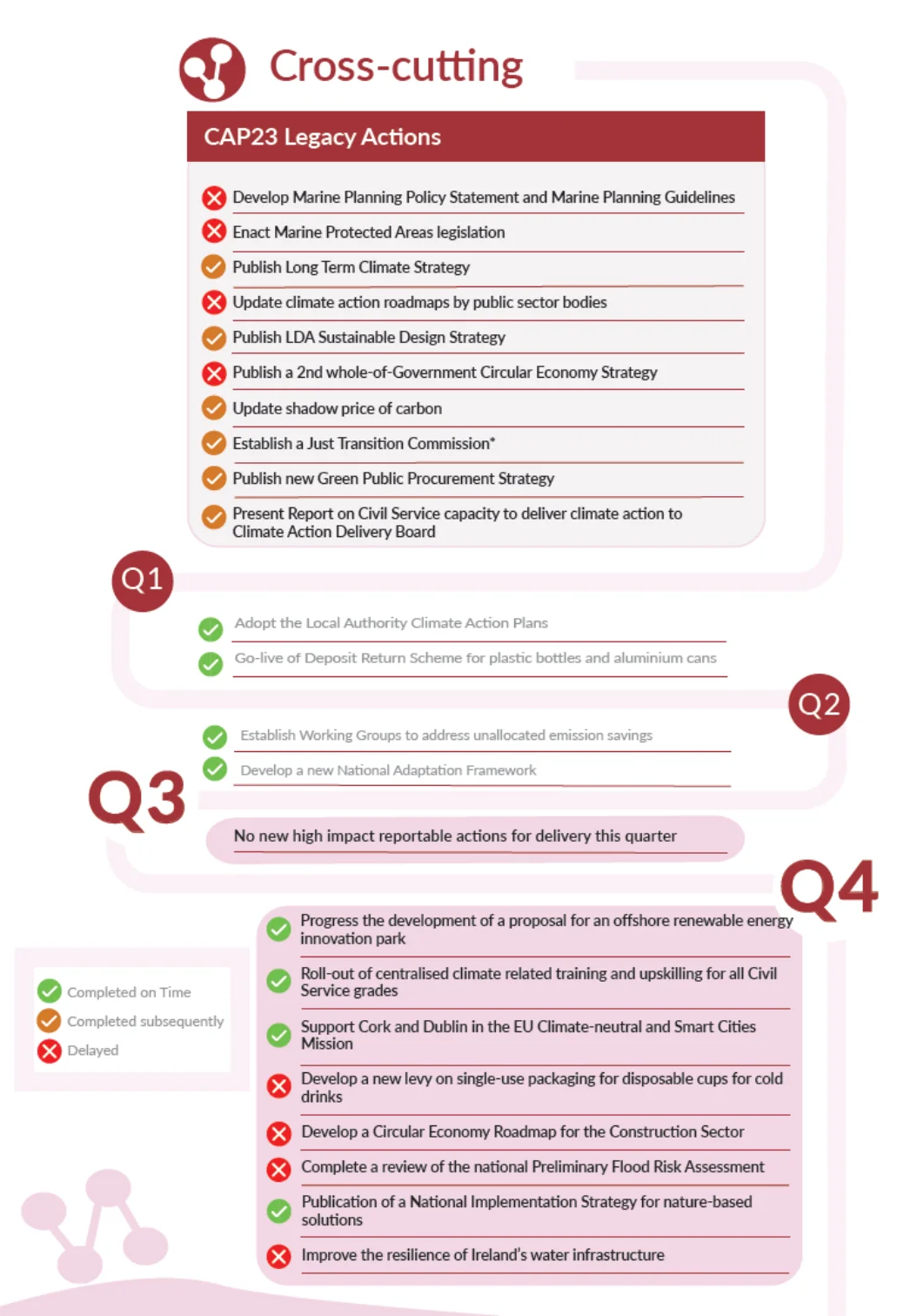
Figure from page 32
Cross-cutting – Completed CAP23 Legacy Action
Did you know? Significant work has been ongoing under successive Climate Action Plans to
review the capacity of the civil service to deliver on climate action, with a view to developing
proposals for implementation that would further the system’s capabilities and address any
identified capacity gaps. Under PS/23/8/B, the Department of the Taoiseach was charged with
presenting such implementation proposals to the Climate Action Delivery Board (CADB) for
consideration. This action completed in Q3 2024.
What’s new? An independent review of civil service climate action capacity was completed by
the Institute of Public Administration, under commission by DPENDR. The final results report
contains a series of recommendations for building climate action capacity in the civil service, with
findings presented to the CADB at its meeting on 31 May 2024.Observations were then sought
from Departments on the draft results. Drawing on this feedback and the IPA recommendations,
implementation proposals were developed and presented to the CADB at its meeting on 19 July
- A formal response to the IPA report has also since been drafted, with further input from
Departments. Both the IPA report and the CADB response are available on the CADB webpage.
Cross-cutting – Delayed CAP23 Legacy Action
Did you know? Under MA/23/2 in CAP23, DECC was due to adopt a statutory Marine Planning
Policy Statement (MPPS) and develop Marine Planning Guidelines to support decision making by
An Bord Pleanála. This action continued to be delayed in 2024.The draft Marine Planning Policy
Statement and associated draft environmental reports completed in November 2024. Public
consultation on the MPPS paused until January 2025 in line with DECC election guidelines but
it is expected that the MPPS will be brought before the Houses of the Oireachtas in Q2 2025.
Why is it needed? Effective and efficient planning is crucial to accelerating sustainable offshore
renewables deployment. The MPPS will describe the existing components of Ireland’s marine
planning system, outline a vision for future development, set overarching policies and principles
to be followed, and establish high-level priorities for the enhancement of the marine planning
system. Marine Planning Guidelines are therefore critical to providing direction to industry to
realise the key resource of offshore renewable energy for Ireland. These planning changes will
help to modernise Ireland’s marine planning system so that it is more integrated, fully plan-led,
clearly structured and user friendly for all marine stakeholders.

Figure from page 33
Cross-cutting – Completed CAP24 Q4 Action
Did you know? UnderPS/24/7, centralised climate training courses were committed for roll-
out across all civil service grades. The Institute of Public Administration was charged with this
task and remain committed to providing a portfolio of sustainability and climate-related
professional development and education programmes suitable for capability and capacity needs
of the public service.
What’s new? In 2024, several new training programmes and upskilling opportunities relevant to
climate action were offered to members of the civil service with the aim of bolstering the
systems capacity to deliver on climate action. This included the NUI accredited Professional
Certificate in Climate Action & Sustainability Reporting (with 16 civil servants graduating in
2024), an ‘Introduction to Climate Change’ eLearning course (with 2,733 civil servants
completing to date since its launch in April 2024) and an IPA self-paced online lecture series in
climate action leadership (with 330 civil servants completing to date). The IPA also convened a
Governance Forum event focused on Putting Sustainability at the Organisational Core that
attracted 150 participants from over 120 public bodies and public benefit entities. A range of
further courses will be commissioned and launched in 2025, providing further in person and
online professional development relevant to climate action and sustainability.

Figure from page 34
Pages 31–34 · View in original PDF