7 Land Use, Land Use Change and Forestry
Using provisional estimates, land use has net emissions of c.5.6Mt CO2 eq in 2023, more than
the emissions from residential buildings (5.3Mt CO2 eq). The Land Use, Land Use Change and
Forestry (LULUCF) sector has been an emissions source in Ireland since 1990. It has a
challenging future profile for emissions generation due to the ageing profile of existing trees,
continued low planting rates and large areas of drained emissive peat soils used for farming,
| Figure 12: Expected LULUCF Emissions |
forestry and peat extraction.
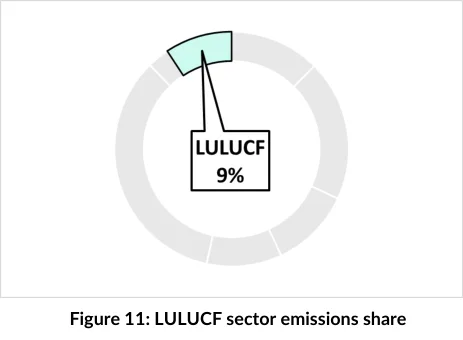
Figure from page 28
Figure 11: LULUCF sector emissions share
The main sources of LULUCF emissions are from
the water table on drained organic soils, and restoring
drained organic (peat) soils for agricultural grassland
peatlands.
use, forestry and peat extraction. Emissions also arise
from the harvesting of an ageing forest estate.
An urgency remains to significantly reduce LULUCF
emissions, with amended EU regulations in this area
LULUCF emissions increased by 40.9% between
holding potential for considerable costs if targets are
2022 and 2023 alone. There has been a considerable
missed. Urgent action is required to meet national
long-term decline in afforestation rates per annum,
and international commitments and ultimate climate
an increase in harvesting and more emissions from
neutrality in Ireland by 2050.
forestry on organic soils than previously thought.
Afforestation rates declined to c.1,573 ha in 2024, a
In the EPA’s State of the Environment report, current
further drop on 2023 levels and well below the 8,000
land uses are reported to be driving pressure on
ha per annum committed to under successive Climate
water quality, biodiversity and GHG emissions. The
Action Plans.
need to approach national land use decisions in a
participatory manner and using a multi-benefit
Under existing measures (WEM) in the EPA
approach is emphasised to address competing social,
projections, emissions from LULUCF are projected to
economic, legislative and environmental needs. The
almost double (99.4% increase) between 2022 and
importance of robust outcomes from the Land Use
2030, largely due to the age class of our forest estate
Review is stressed to identify land use opportunities
reaching harvest maturity. Planned policies (WAM)
and constraints and thereby support more evidence-
would reduce the extent of emissions increase to
based decision making in the sector.
23%, highlighting the need for rapid tree planting on
mineral soils,adjusted forest management, raising

Figure from page 28
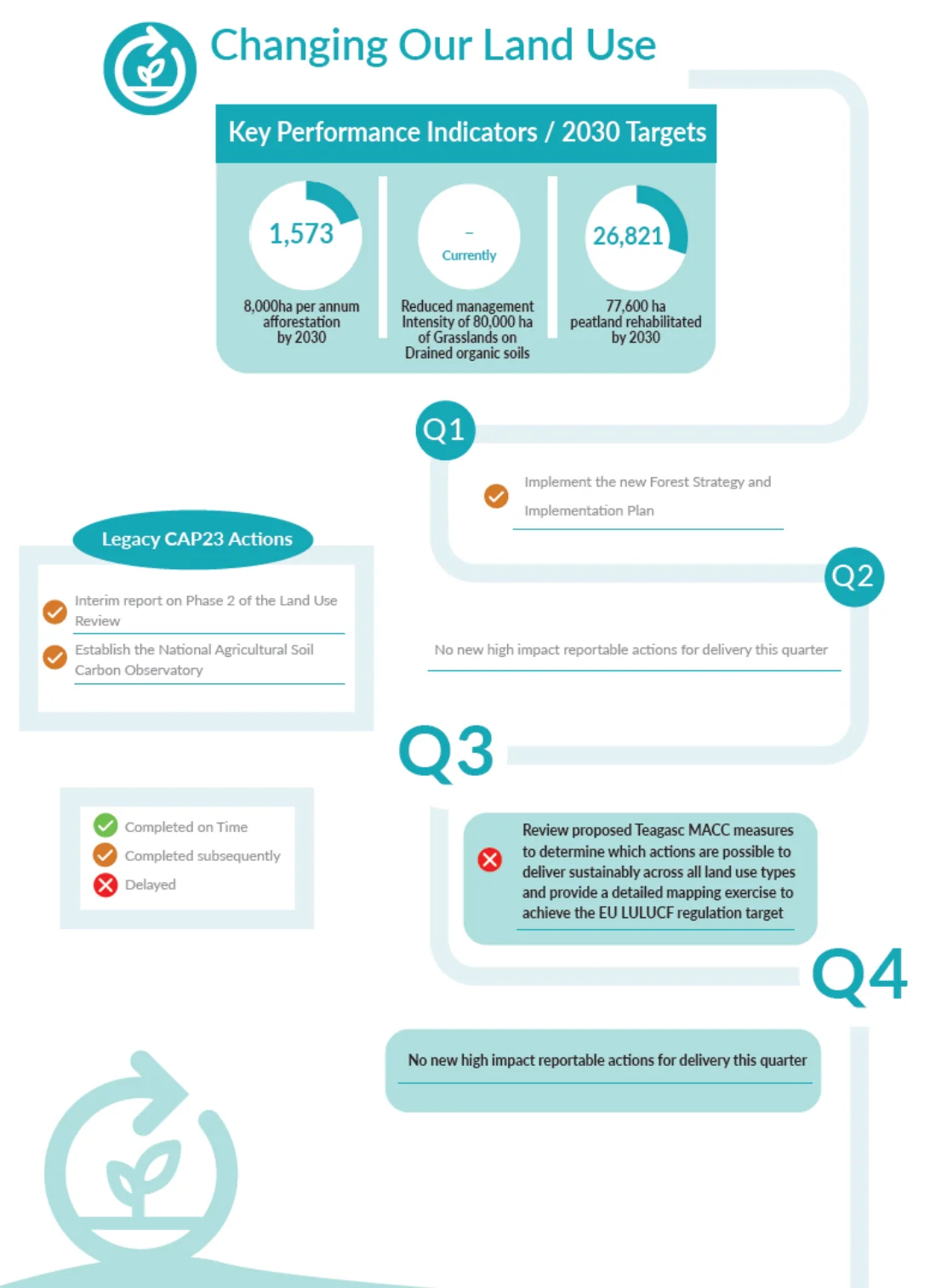
Figure from page 29
LULUCF – Completed CAP24 Q1 Action
Did you know? As part of the implementation of the new Forestry Strategy and Programme
2023-2027, a forestry consultative committee and new communications plan was developed
under CAP24 to promote activity in the sector. Increased tree planting and enhanced forest
management is crucial to achieving both climate and dedicated LULUCF targets established at
national and EU level. Significant costs for non-compliance are predicted to arise in the case of
the EU LULUCF Regulation, with increased afforestation critical to improving Ireland’s carbon
sink in the longer term.
What’s new? A comprehensive communications plan has now been put in place involving direct
messaging, print, radio and social media channels to promote the benefits of the Forestry
Programme 2023-2027. This includes distribution of a Farm Forestry Booklet, leaflets on the
Native Tree Area scheme, focussed information campaigns on Ash Dieback and the Climate
Action Performance Payment, forestry town halls and intense advertising in advance of the new
planting season. Further, a new Forest Strategy Consultative Committee formed in January 2024
to contribute to the implementation of the new Forest Strategy, with sub-groups on
afforestation and Ash Dieback already meeting quarterly.
LULUCF – Delayed CAP24 Q4 Action
Did you know? Under JM/24/5, a consortium was due to be appointed to deliver on the
Midlands Carbon Catchment Study (MCCS). The study is a key part of the research, knowledge
transfer and monitoring activities required to inform the development of rewetting measures for
farmed (drained) peat soils. The project commencement suffered delays due to funding issues,
whereby the original intention to utilise funds under the Just Transition Fund Framework was
deemed not feasible.An appropriate delivery and funding framework is being considered within
DAFM and proposals will now be brought forward in 2025 to support delivery of the MCCS.
Why is it needed? CAP21 established a target to rewet 80,000 ha of drained peat soils used for
farming (mostly grassland for grazing animals) which represents a significant emissions source in
Ireland. The MCCS is due to deliver 10,000ha of this target. Action is needed immediately to
course-correct projected emissions increasesin the LULUCF sector, to enhance our national
carbon sink towards achieving climate neutrality and to avoid compliance costs at EU level for
missing legally-binding targets. As with any significant land use change there is a need to provide
certainty and long-term support for such activities and hence the necessity to establish the most
appropriate funding delivery framework that supports landowner decision-making and action in
the near- and future-term.
Pages 28–30 · View in original PDF