6 Industry
Industrial emissions accounted for 10% of Ireland’s total emissions in 2023.
Manufacturing combustion and industrial processes are the key emissions sources.
Industry emissions are largely affected by cement production in Ireland, which in turn
can be impacted by economic cycles.
| Figure 10: Gap to Target - Industry |
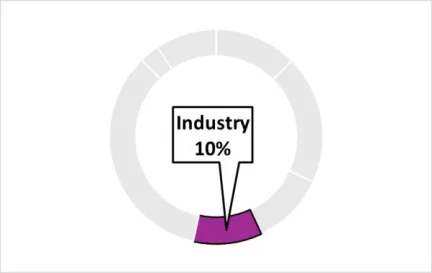
Figure 9: Industry sector emissions share
The EPA projections note that manufacturing
In the H2-published State of the Environment Report
combustion emissions could reduce by 12-32% over
2024, the EPA states that compliance with
the period 2022-2030 with the implementation of
environmental regulation across industry in Ireland is
energy efficiency measures and renewable heat
high overall. However, a disproportionate number of
options in industry (Figure 10). Achieving full
sites in the food and drinks sector (in particular dairy
biomethane targets (with use split across building and
processing) and in the waste sector are not
industry needs) is also required to meet the upper
performing optimally and remain consistently on the
end of the range in this sector.
EPA’s priority ‘watch list’ for excessive pollution. This
Meanwhile, process emissions are projected to
helps the EPA to target its enforcement effort at the
increase by 4% between 2022 and 2030 in the EPA’s
licensed operators with the poorest environmental
WEM scenario due to anticipated growth in cement
performance.
production. There is no WAM scenario for process
The EPA further questions Irish policy reliance on
emissions as no additional measures are yet identified
voluntary and incentive-based instruments to
in CAP, or otherwise, to address them.
transition industry to clean energy. Specific areas
The EPA was unable to model measures aimed at
highlighted where industry needs to act include with
decreasing embodied carbon in construction or the
respect to carbon-neutral heating, CCUS, use of zero-
use of Carbon Capture, Utilisation and Storage
emissions gas and improved energy efficiency.
(CCUS) in industry post-2030 due to unclear
Continued investment and practice change are
implementation pathways. Policy elaboration and
needed to ensure compliance with tighter
implementation is required in these areas if industry
environmental standards and to achieve the
is to rely on their deployment to meet emissions
industrial emissions reductions that are required.
reduction targets.
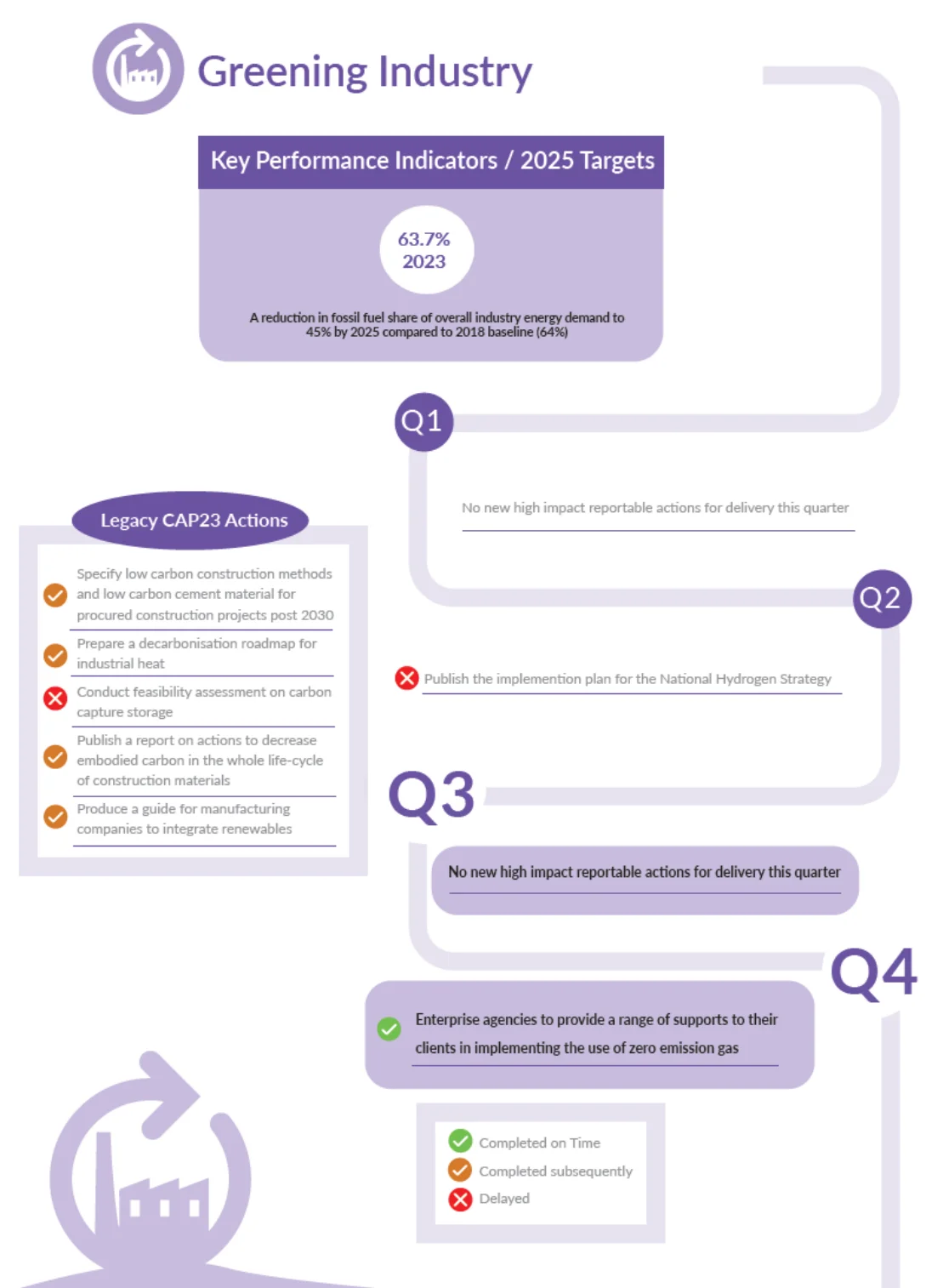
Figure from page 26
Industry – Completed CAP24 Q4 Action
Did you know? Decarbonised gases such as green hydrogen, biogas and biomethane can reduce
emissions arising from medium and high temperature heat processing in industry (e.g. as used in
food and drink, chemical and pulp/paper processing). Enterprise Ireland and IDA Ireland are
working closely with client companies in manufacturing sectors to assess which processes and
operations can utilise decarbonised gases sustainably and cost effectively.
What’s new? Under CAP24 Action IN/24/7, Enterprise Ireland, through its capital grant
schemes, Environmental Aid and the Capital Investment for Decarbonisation Processes,
supports the development of on-site biomethane production for heat use for industrial users.
In November, Enterprise Ireland approved over €55 million in funding to support the
decarbonisation of Irish businesses. The funding has benefited more than 400 Irish companies
since June 2022, reducing CO2 emissions by an estimated 130,000 tonnes to date. Under
IN/24/2, DETE allocated a further €300 million in 2024 to the Environmental Aid scheme to
further sustainable growth among Irish companies. Similarly, the SEAI Support Scheme for
Renewable Heat (SSRH) provides a 15-year operational tariff support for businesses to
operate new biomass and biogas heating systems, as well as installation grants for commercial
heat pumps, further helping businesses move from fossil fuels to renewable heating.
Industry – Delayed CAP24 Q2 Action
Did you know? Under IN/24/8, DECC were due to publish an implementation plan for the
National Hydrogen Strategyand to establish appropriate governance arrangements for its
delivery. This action had yet to complete by end of Q4 2024. Delays occurred during the
procurement of consultancy and project management services to support its delivery. These
delays have now been resolved and with an implementation plan expected in Q1 2025.
Why is it needed? Ireland’s abundant wind and renewable energy resources position it well for
green hydrogen production, including when using excess energy from offshore wind generation.
Green hydrogen can act as a critical component in decarbonising sectors that are difficult to
electrify, like heavy industry and parts of the transport system such as shipping. Investment in
green hydrogen production, storage, and distribution is in its early stages but Ireland’s green
hydrogen could become a significant export opportunity with potential to supply the growing
demand for clean energy in Europe. An implementation plan, with timebound actions and owners
for delivery, would provide a clear roadmap for all stakeholders and help to accelerate progress.

Figure from page 27
Pages 25–27 · View in original PDF