5 Buildings
In total, 11% of Ireland’s emissions in 2023 came from Buildings (mostly residential
buildings). The sector has seen GHG reductions of approximately 7% since 2022. Several
factors can influence annual emissions from buildings including energy prices, yearly
temperatures, energy efficiency measures, fuel switching, and remote working.
| Figure 8: Gap to Target - Buildings |
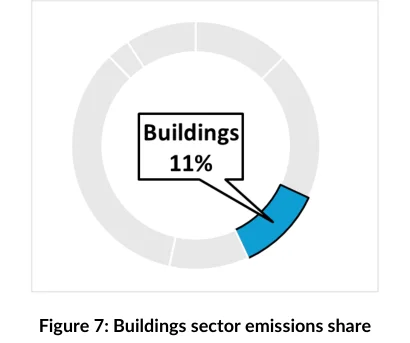
Figure from page 22
Figure 7: Buildings sector emissions share
The EPA has projected that emissions from
residential buildings will decrease by 15%-27%
between 2022 and 2030, and 19-57% for
Commercial and Public Services (Figure 8).The higher
savings assume full implementation of the ambitious
actions and targets outlined in CAP24 for the sector.
This includes measures such as:
the installation of 680,000 heat pumps by 2030 retrofitting 500,000 homes to the cost-optimal equivalent of a ‘B2’ building energy rating by 2030, no new oil boilers installed in new dwellings from 2022, or gas boilers from 2025, and district heating growing to 1.2 TWh by 2030.
The EPA’s 2024 State of the Environment report
commends significant progress in the buildings sector
to date, noting that the greatest progress towards
sectoral emissions ceilings for energy-related
emissions has taken place in buildings (residential,
commercial and public). While the number of total
households increased from 1 million in 1990 to 1.9
million in 2023, emissions from the sector in 2023 are
still slightly below 1990 levels. This was achieved by

Figure from page 22
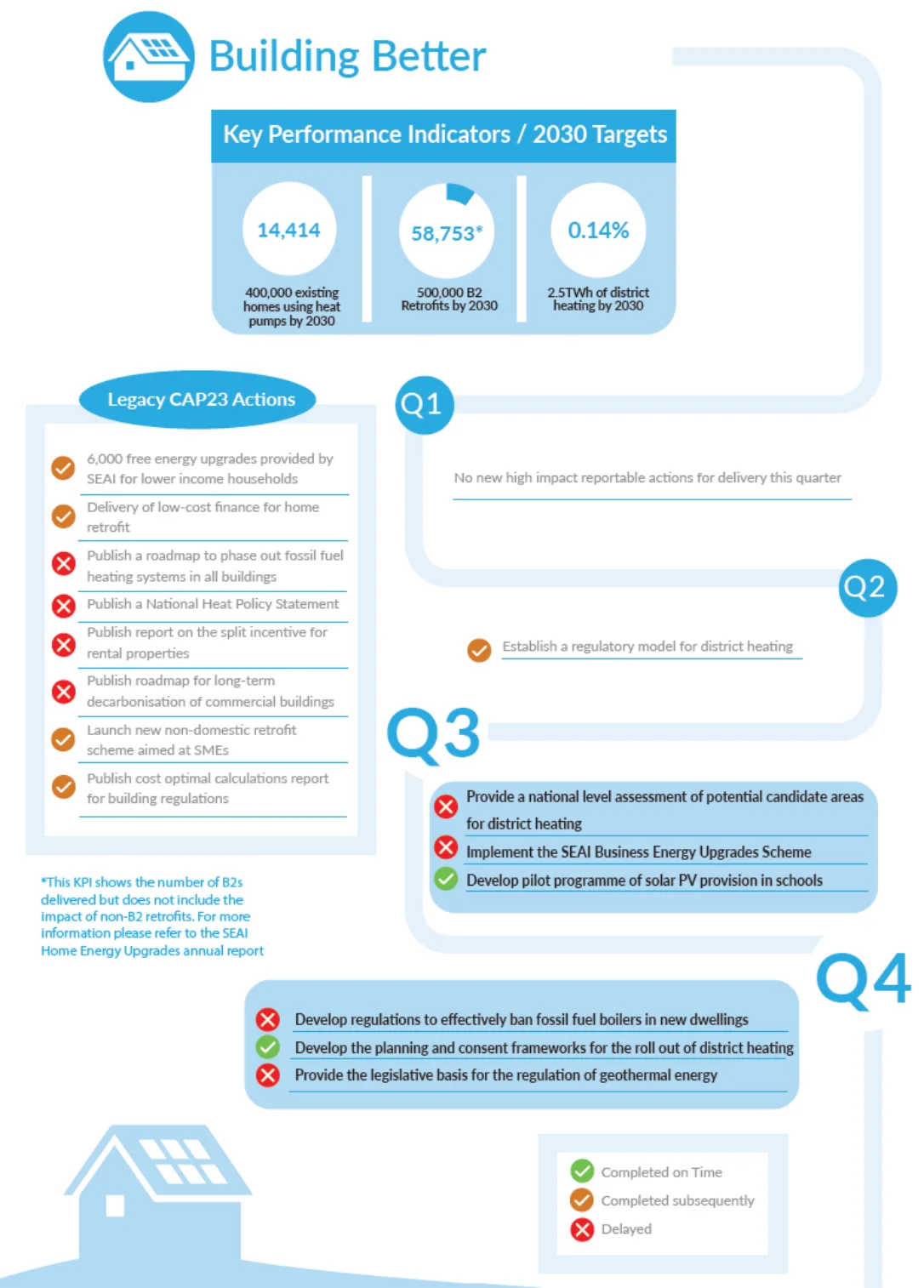
Figure from page 23
Buildings – Completed CAP24 Q3 Action
Did you know? Under BE/24/22, the Department of Education was charged with rolling out a
pilot programme of solar panel provision in schools, with the goal of installing solar panels in
c.1,000 schools by the end of Q3. This was achieved, marking an important milestone in the
generation of renewable electricity across the Irish school network. This helps to reduce
emissions nationwide, lessen energy running costs in schools buildings and provides security of
energy supply.
What’s new? The Schools PV Programme launched in November 2023. As part of the
programme’s first phase, over 1,120 schools have received funding approval for PV panel
installations, with almost 1,030 installations completed to date. In November 2024, the second
phase launched, extending the scheme to all remaining eligible schools, with 2,189 schools now
approved to proceed to tender and 755 of those so far approved for funding and 17 confirmed
installations to date. The programme is an important part of the public sector leading by example
in climate action and providing opportunities to inspire other local business, households and
community centres to take part in the energy transition.
Buildings – Delayed CAP24 Q4 Action
Did you know? Under BE/24/1, DHLGH were due to develop regulations and procedures to
effectively ban fossil fuel boilers in new dwellings and those undergoing major renovation. While
fossil fuel boilers have been effectively phased out for new dwellings because of Nearly Zero
Energy Building (NZEB) performance requirements already in place, delays were encountered in
finalising regulations pertinent to renovations. A public consultation on this aspect commenced
in December and will lead to an amendment to relevant Technical Guidance Documents in Q1
Why is it needed? Electric heating systems, the majority of which involve heat pumps, were
installed in 97% of new dwellings in 2023, significantly reducing emissions in heating these
buildings (subject to renewable energy supply). It is essential that the same rules apply to
buildings undergoing major renovation to speed up the transition to electric heating across
existing dwellings. This will also require further development of the supply chain for heat pumps
so that the technology becomes the default solution for householders outside of a district
heating network, along with necessary building insulation upgrades when choosing a new
heating system in the coming years.

Figure from page 24
Pages 22–24 · View in original PDF