3 Transport
In 2023, Transport was responsible for 20% of total greenhouse gas emissions in Ireland
(inclusive of LULUCF). The emissions from this sector are the second biggest (after
Agriculture) and have faced the largest increase of all sectors since 1990. As can be
seen in Figure 4, the measures implemented, and speed at which this takes place, will
determine the rate at which transport emissions decline by 2030 (between 5-26%,
| Figure 4: Gap to Target – Transport | |||
|---|---|---|---|
according to EPA projections).
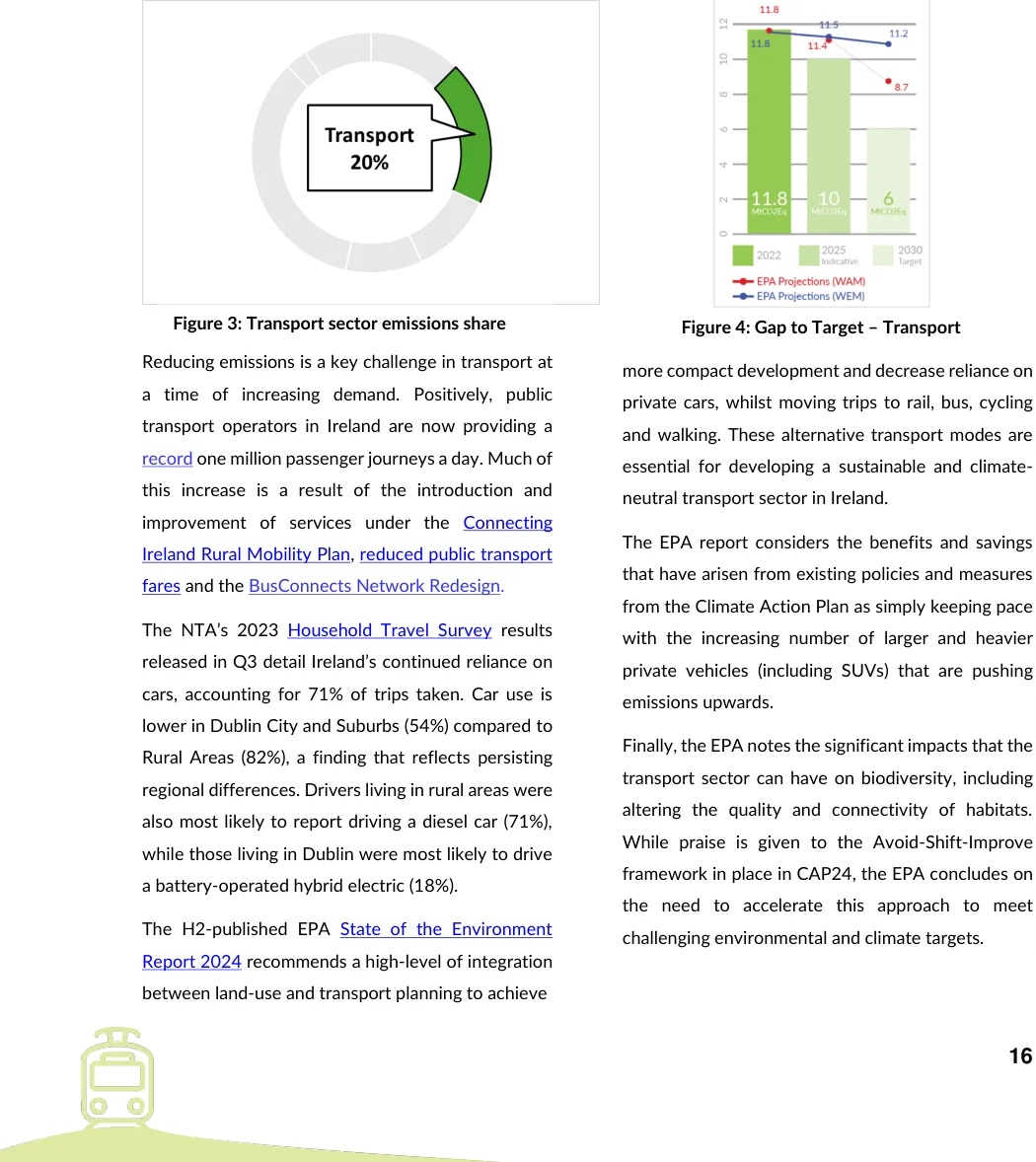
Figure from page 16
Figure 3: Transport sector emissions share
Reducing emissions is a key challenge in transport at
more compact development and decrease reliance on
a time of increasing demand. Positively, public
private cars, whilst moving trips to rail, bus, cycling
transport operators in Ireland are now providing a
and walking. These alternative transport modes are
record one million passenger journeys a day. Much of
essential for developing a sustainable and climate-
this increase is a result of the introduction and
neutral transport sector in Ireland.
improvement of services under the Connecting
The EPA report considers the benefits and savings
Ireland Rural Mobility Plan, reduced public transport
that have arisen from existing policies and measures
fares and the BusConnects Network Redesign.
from the Climate Action Plan as simply keeping pace
The NTA’s 2023 Household Travel Survey results
with the increasing number of larger and heavier
released in Q3 detail Ireland’s continued reliance on
private vehicles (including SUVs) that are pushing
cars, accounting for 71% of trips taken. Car use is
emissions upwards.
lower in Dublin City and Suburbs (54%) compared to
Finally, the EPA notes the significant impacts that the
Rural Areas (82%), a finding that reflects persisting
transport sector can have on biodiversity, including
regional differences. Drivers living in rural areas were
altering the quality and connectivity of habitats.
also most likely to report driving a diesel car (71%),
While praise is given to the Avoid-Shift-Improve
while those living in Dublin were most likely to drive
framework in place in CAP24, the EPA concludes on
a battery-operated hybrid electric (18%).
the need to accelerate this approach to meet
The H2-published EPA State of the Environment
challenging environmental and climate targets.
Report 2024recommends a high-level of integration
between land-use and transport planning to achieve
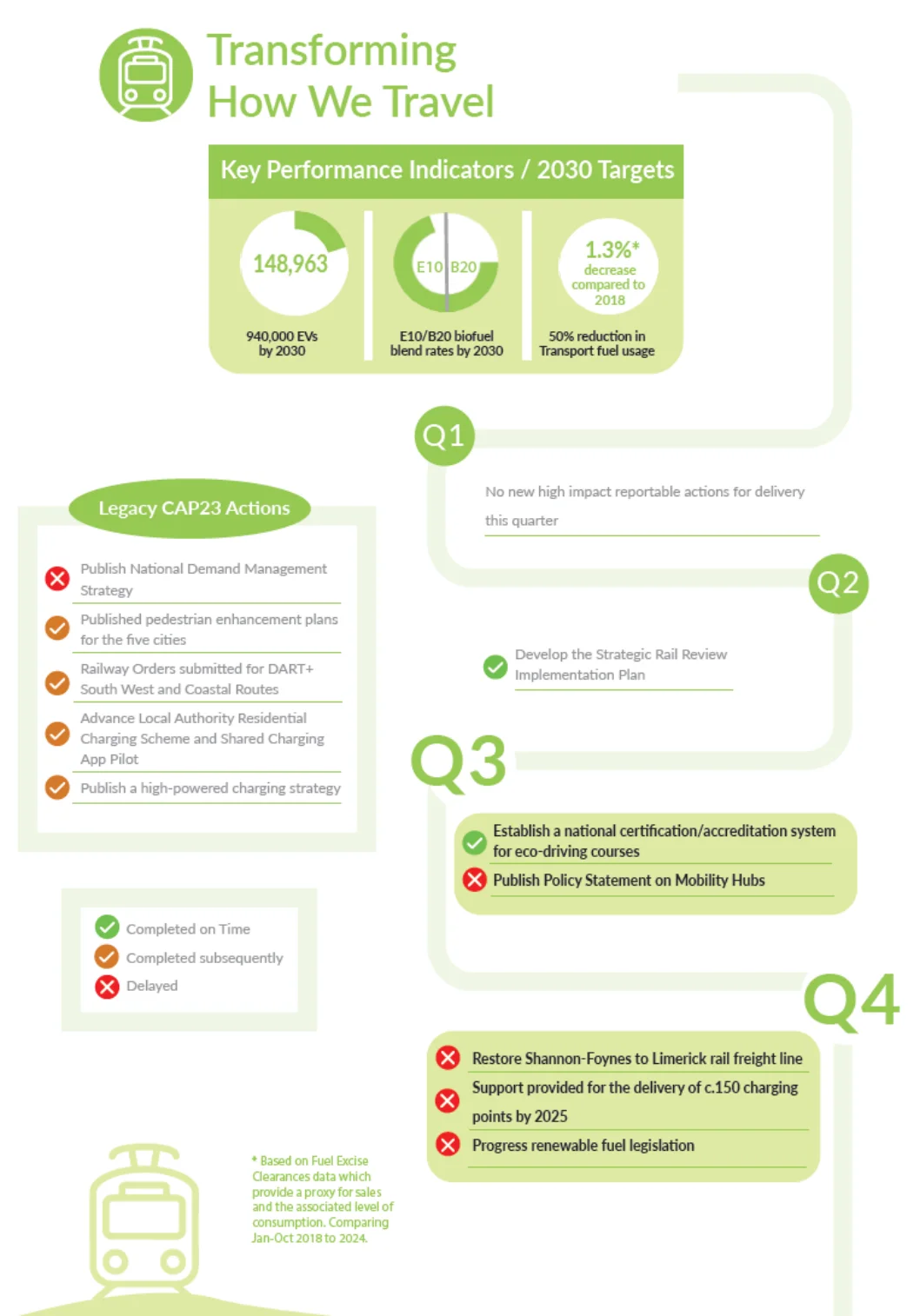
Figure from page 17
Transport – Completed CAP24 Q4 Action
Did you know? With continued increases in passenger numbers, the electrification of public
buses is essential to decarbonise public transport operations. Action TR/24/19 committed to
advance the electrification of Public Service Obligation (PSO) bus services, including both electric
bus fleet procurement and depot charging upgrades. A procurement framework is now in place
to deliver 800 electric buses over a five-year period, with CAP24 committing to c.120 double-
deck battery electric buses entering passenger service by the end of Q4 2024.
What’s new? All 120 double-deck electric buses from the first procurement order entered
passenger service by the end of 2024. As planned, 100 of these buses are in Dublin and the
remaining 20 are in Limerick. The number of electric buses in passenger service is expected to
increase during 2025 as more of the teething issues identified with buses and charging
infrastructure are resolved. A total of 136 high-power charging guns are now also available at
Dublin Bus depots in Dublin. Combined, these activities serve to cut reliance on fossil fuels,
reducing emissions from the transport sector. Looking to the future, the National Transport
Authority intends that 85% of the Dublin Metropolitan Area urban bus network will be operated
by low and zero emission buses by 2032, and solely by zero emission buses by 2035.
Transport – Delayed CAP24 Q3 Action
Did you know? Both the Sustainable Mobility Policy (SMP) and CAP24 include actions to expand
the availability of shared mobility options in Ireland that could lessen reliance on individualised
transport ownership and modes. To progress this objective, the development and publication of
a Policy Statement on Mobility Hubs was included as a Q3 Action (TR/24/17 TF) under CAP24,
which has not completed yet. Combined, the actions commit the Department of Transport to
working closely with shared mobility services providers and partnerships to develop more
coherent policy and supports - including technical innovation and appropriate regulation - to
scale up shared mobility services around the country.
Why is it needed? Shared mobility policies can reduce individual car-dependency, curb related
emissions and increase well-being. Mobility Hubs incorporate a variety of shared mobility
solutions including micro-modes, bikes, e-bikes, cargo bikes and e-cars for shared use, with plans
to be delivered at scale across the five cities in Ireland. Following a public consultation, a draft
of the Policy Statement was completed in 2024, and will be ready for consideration by the new
Government in Q1 2025. Subject to approval, it is now hoped to publish the final Statement by
Q2 2025.

Figure from page 18
Pages 16–18 · View in original PDF