7 Industry
Share of GHGs
Industrial emissions accounted for 9.7% of Ireland’s total emissions in
in Ireland in
2022, with manufacturing combustion and industrial processes as the
2022
key emissions sources. These emissions are largely affected by cement
9.7%
production in Ireland, with emissions increasing, for example, in times
of economic boom and when Covid-19 restrictions relaxed.
The EPA projections report notes that manufacturing combustion emissions
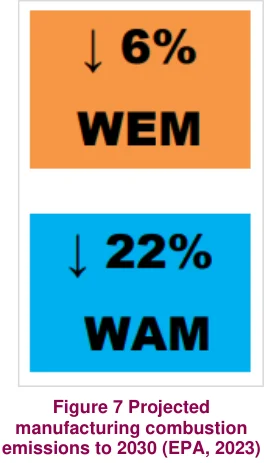
Figure from page 30
will reduce by 6-22% from 2021 to 2030 with the implementation of efficiency
measures and renewable heat generation in Irish industries. The full
implementation of biomethane targets (with use split across heating in
buildings as well as meeting industry needs) is also required to meet the
upper end of this range.
Meanwhile, process emissions are projected to increase by 5% in the same
time period under the EPA’s WEM scenario due to anticipated increased
cement production. There is no WAM scenario for process emissions as no
additional measures are yet identified in annual CAPs, or otherwise, to
address them.
Figure 7 Projected manufacturing combustion emissions to 2030 (EPA, 2023)
The EPA were unable to model the full CAP23 targets for renewable
heating in industry nor measures aimed at decreasing embodied carbon in construction
materials due to unclear implementation pathways. The use of Carbon Capture, Utilisation
and Storage (CCUS) in industry post-2030 was also not included for the same reason. The
industry SEC is thus expected to be breached by quite a significant margin according to the
EPA, without better defined emissions reducing pathways.
The draft CAP24 notes the key measures to decarbonise the industry sector include
increasing carbon-neutral heating in industrial manufacturing processes; decreasing
embodied carbon in construction materials; and reducing fossil fuel demand through
enhanced energy efficiency measures across industry. Actions highlighted for this sector in
CAP24 include expanding and enhancing supports from the SEAI, IDA Ireland, and
Enterprise Ireland to achieve energy demand reduction, enhanced electrification, and
biomass adoption in industry. The development of a CCUS strategy to provide a clear policy
framework to guide long-term investment decisions is also committed to by Q3 2024.
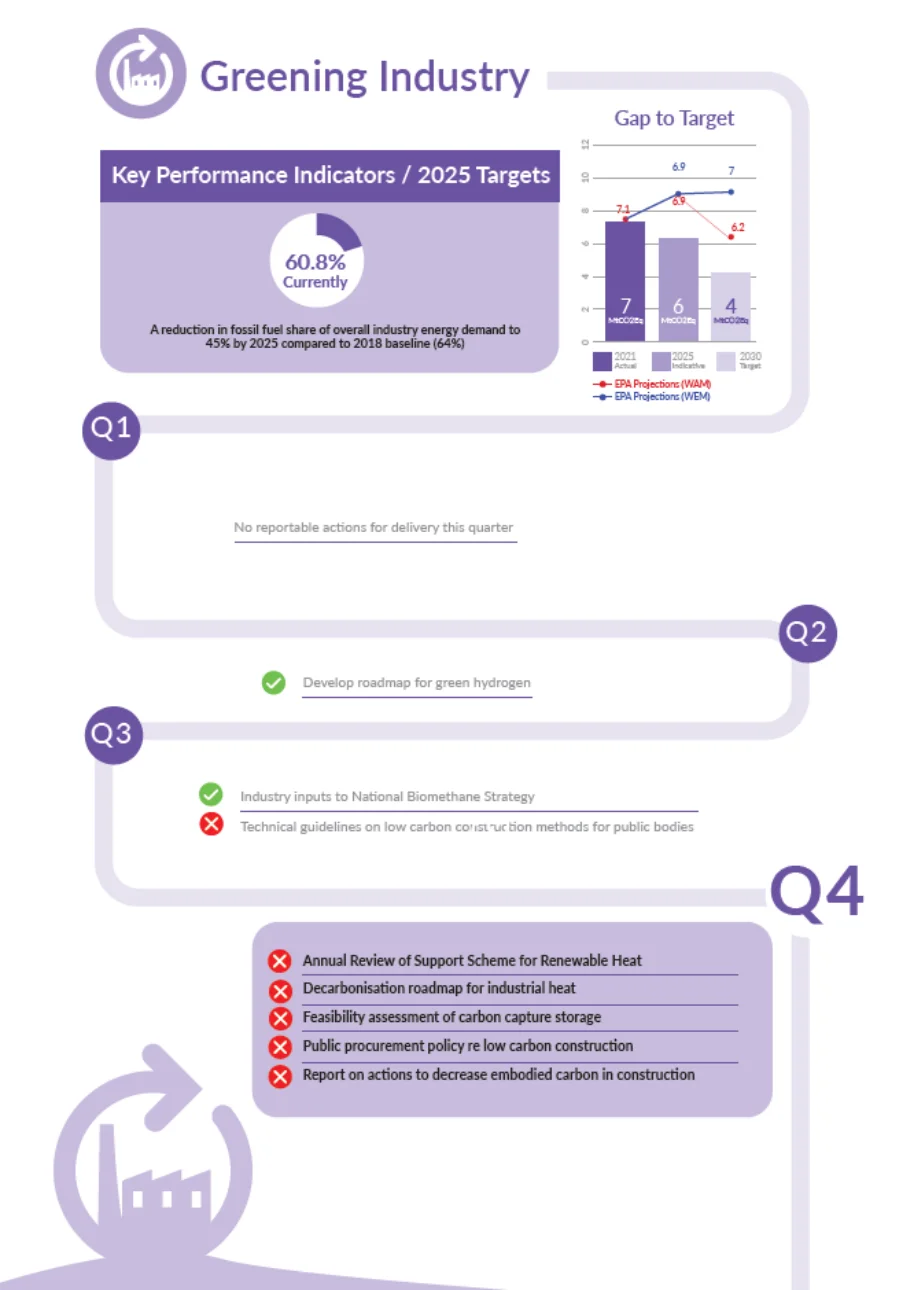
Figure from page 31
| High Impact Action Delayed in Q4 2023: Industry | ||
| Did You Know? Under action EN/23/3, DETE sought to prepare a decarbonisation | ||
| roadmap for industrial heat in Q4 2023. This roadmap was delayed in Q4 but is now | ||
| being reviewed in advance of publication, which is expected shortly. This work will be | ||
| based on the recommendations of the SEAI National Heat Study which provides a | ||
| comprehensive assessment of the options available to decarbonise Ireland’s energy | ||
| used for heating and cooling homes, businesses, and industry. | ||
| Why is it needed? Carbon abatement in industry requires improvements in energy | ||
| efficiency; greater electrification of low-to-medium temperature heating; and increased | ||
| supply and use of biomethane and green hydrogen for higher temperature purposes. | ||
| The National Heat Study notes that a clear signal is required for fuel switching in | ||
| industry, which this action EN/23/3 could provide. A timetable for the phase out of fossil | ||
| fuels, a switch to green hydrogen or biomethane use on the gas grid and a combination | ||
| of the use of district heating and heat pumps will play a vital role in fast decarbonisation | ||
| of industry in Ireland. This needs to be clearly mapped out to promote the required | ||
| behavioural changes and investment. |
| High Impact Action Delayed in Q4 2023: Industry | ||
| Did You Know? Under action EN/23/6, DECC were to conduct a feasibility assessment | ||
| on carbon capture and storage (CCS). CCS involves capturing the carbon dioxide | ||
| produced by power generation or industrial activity and then storing it through | ||
| sequestering it in geological formations or within materials. | ||
| Why is it needed? CCS is particularly suited to capturing the emissions from sources | ||
| such as in industry and energy production. A strategy in this space is essential to provide | ||
| a clear policy framework to guide long-term investment decisions. CCS will play a key | ||
| role in the industry decarbonisation pathway, particularly in difficult-to-abate areas. The | ||
| National Heat Study also recognises the importance of carbon capture and storage. A | ||
| Carbon Capture, Utilisation and Storage (CCUS) Strategy is now committed to by Q3 | ||
| 2024 under the draft CAP24. |
Pages 30–32 · View in original PDF