5 Buildings
Share of GHGs
Emissions from all buildings made up 11.1% of Ireland’s emissions in 2022.
in Ireland in
Most of this (9%) was from residential buildings. Energy prices, yearly
2022
temperatures, energy efficiency measures, fuel switching, and remote
11.1%
working have all influenced emissions from buildings of late.
In the EPA projections, emissions from residential buildings are expected to
| (WEM) (WAM) | |
|---|---|
| Figure 4 Projected emissions from Residential sector (EPA, 2023) |
decrease by 36 - 47% between 2021 and 2030 (Figure 4). The higher
reduction level assumes, among other actions, a ban on oil and gas boilers in
new dwellings, the installation of 680,000 heat pumps, 500,000 B2 home
retrofits/cost optimal equivalents, and the implementation of full district
heating and biomethane targets to decarbonise heating sources.
With full implementation of ambitious CAP23 measures, residential and
commercial buildings are expected to meet 2030 emissions reduction targets.
Cumulative emissions however mean that the commercial buildings SEC will
be breached, with the residential SEC projected to remain within limits in the
second carbon budget period only.
For Commercial and Public Services, a decrease of 19 - 49% is projected by
the EPA (Figure 5). Accelerated retrofitting of private, public, and commercial
buildings is required going forward, as re-committed to under the draft
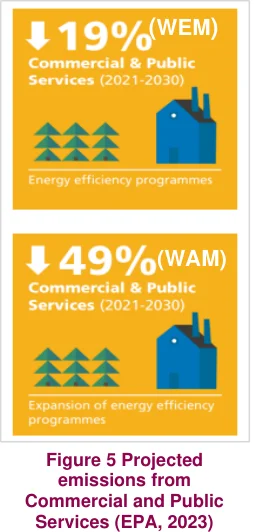
Figure 4 Projected
CAP24, along with the expansion of renewable heating options such as
(WEM)
district heating and electric heat pumps.
Alongside retrofit and renewable heat activity to decarbonise existing
buildings, CAP24 re-states the target for all new dwellings to be designed
and constructed to Nearly Zero Energy Building standard by 2025, and Zero
Emission Building standard by 2030. This will help to prevent new emissions
(WAM)
from the sector as building stock grows.
Key measures and actions signposted in the draft CAP24 to reduce
emissions from buildings include: continued roll-out of an ambitious National
Residential Retrofit Plan; strengthening building regulations; supporting the
development of district heating, electrification of heating, and geothermal
energy; implementation of the Renewable Heat Obligation and roadmaps and
Figure 5 Projected
emissions from Commercial and Public
supports to decabonise commerical and public buildings.
Services (EPA, 2023)
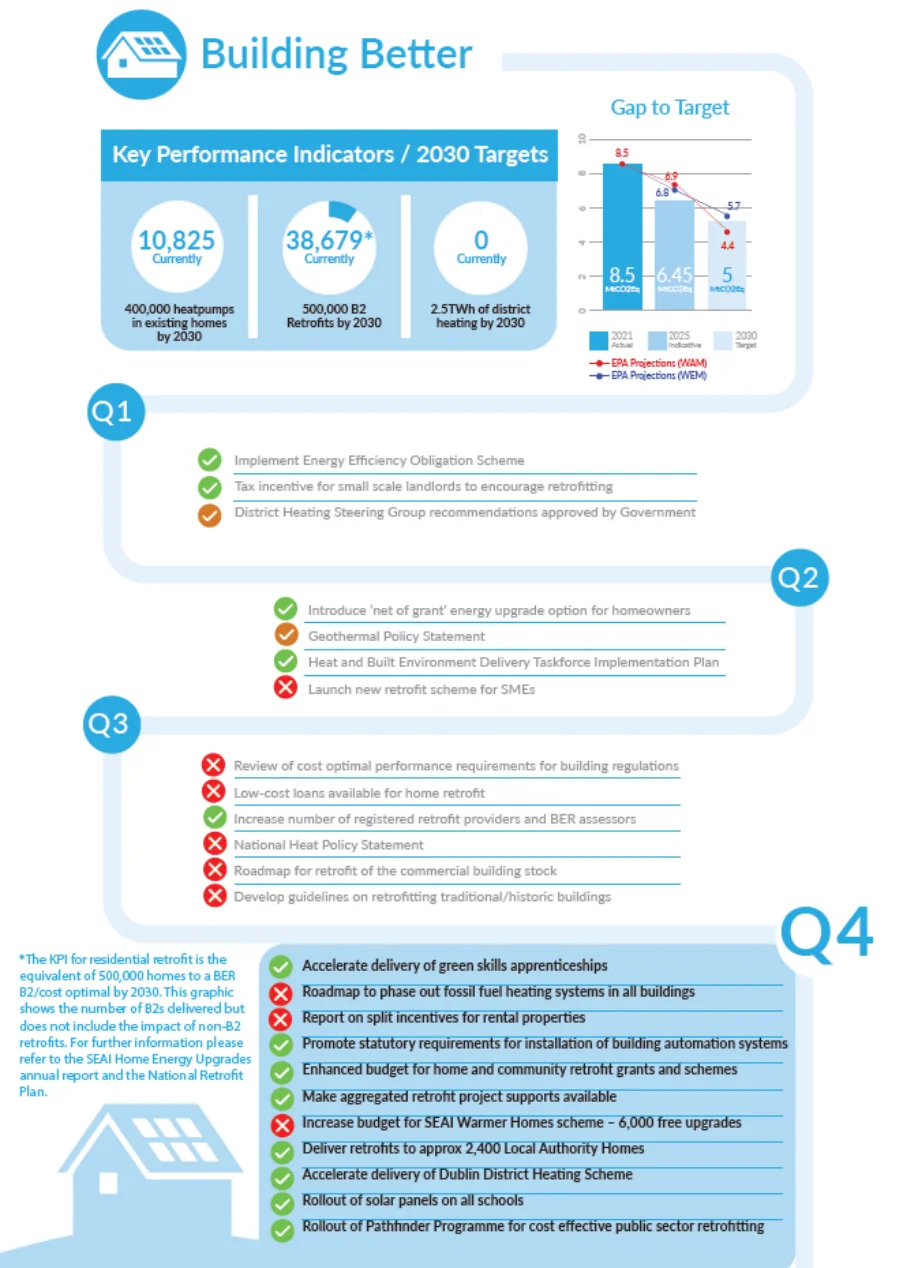
Figure from page 24
| High Impact Action Complete in Q4 2023: Buildings | ||
| Did You Know? Under action BE/23/5 in CAP23, DECC committed to provide a record | ||
| budget allocation for SEAI residential and community retrofit schemes in 2023. This was | ||
| confirmed in Q4, with preliminary data showing significant growth in the delivery of home | ||
| energy upgrades supported by SEAI grants. Across schemes, over 47,800 property | ||
| upgrades were supported in 2023 - a 76% increase on 2022. Of which, over 17,400 were | ||
| upgraded to a Building Energy Rating of B2 or better - a 106% increase on 2022. | ||
| What’s new? Completion and continuation of this action is important to drive retrofit | ||
| demand and activity at scale and support homeowners, businesses, and community | ||
| organisations in the climate neutral transition. This will help to reduce emissions from | ||
| buildings and create a host of additional benefits for occupants including warmer, more | ||
| comfortable places to live and work, as well as helping to lower energy bills. 64,300 | ||
| applications for grant support were received by SEAI in 2023 equating to a 28% increase | ||
| on 2022 levels. This indicates a strong pipeline of works for 2024. |
| High Impact Action Delayed in Q4 2023: Buildings | ||
| Did You Know? A National Heat Policy Statement was due to publish in Q4 2023 under | ||
| action BE/23/26. This Statement intended to build on findings of the National Heat Study | ||
| conducted by SEAI that identified the options available to decarbonise Ireland’s energy | ||
| used for heating and cooling homes, businesses and industry. Screening on the Heat | ||
| Policy Statement completed in Q4, and the outcome identified that a full Strategic | ||
| Environmental Assessment (SEA) / Appropriate Assessment (AA) is required. Initial | ||
| statutory consultations are progressing, but this delayed the finalisation of the Statement | ||
| in Q4 as originally intended. | ||
| Why is it needed? A National Heat Policy Statement is essential to provide clarity on | ||
| planned pathways towards climate neutrality for Irish buildings. This includes, among | ||
| other elements, decisions on the future use of fossil fuels in buildings, with implications | ||
| for refurbishments, fuel purchases, renewable heat planning and planned boiler | ||
| replacements. The publication of the Statement is essential to outline, to all | ||
| stakeholders, the comprehensive approach to decarbonising the heat sector in Ireland. |
| High Impact Action Delayed in Q4 2023: Buildings (Commercial) | ||
| Did You Know? In CAP23, under the action BE/23/31, DETE were to develop a detailed | ||
| roadmap for long-term decarbonisation of commercial buildings. This action is delayed | ||
| but is expected to publish shortly once approved by the Commercial Built Environment | ||
| Working Group and presented to Government for information. This is expected by the | ||
| end of Q1 2024. | ||
| Why is it needed? The retrofit of Ireland’s commercial buildings is central to reaching | ||
| our 2030 and 2050 national and international decarbonisation targets. The European | ||
| Green Deal sets our national target for all buildings to be net zero emissions by 2050. | ||
| The roadmap for long-term decarbonisation of commercial buildings is a key document | ||
| for Irish businesses that will communicate policy decisions and pathways to | ||
| decarbonisation. The roadmap will be an important tool for signalling to businesses and | ||
| generating investment and buy-in. |
Pages 23–26 · View in original PDF