4 Electricity
Share of GHGs
Energy industries (primarily power generation) accounted for 14.4% of
in Ireland in
national emissions in 2022. Electricity emissions decreased by 2% in
2022
2022 due to an increase in renewable (e.g. wind and solar) generation,
14.4%
coupled with reductions in coal, oil, and peat use. In 2022, renewables
accounted for 38.6% of electricity generation in Ireland, an increase from
35% in 2021. CAP23 committed to achieving 80% of electricity demand
from renewable sources by 2030. The proposed pathway to achieve our
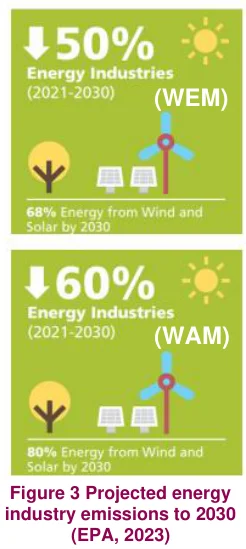
Figure from page 19
renewable ambition in the electricity sector is detailed in EirGrid’s Shaping
our Electricity Future.
(WEM)
An Offshore Wind Delivery Taskforce was established in 2022 and has
developed a system-wide implementation plan for offshore renewables. An
Accelerating Renewable Electricity Taskforce was established in 2023 to
identify, coordinate, and prioritise the development and implementation of
policies required to meet our 2030 onshore renewable targets.
The EPA projections report showed that increased renewable energy
(WAM)
generation from wind and solar, if delivered as rapidly as planned, can
reduce energy industry emissions by 50-60% by 2030 and achieve over
80% renewable electricity generation (Figure 3). Sectoral targets and
emissions ceilings established for the sector are however projected to be
Figure 3 Projected energy industry emissions to 2030
missed, even in the higher ambition scenario.
(EPA, 2023)
The draft CAP24 sets out further policies and measure to help meet targets in this sector.
This includes methods to enable industrial heating facilities to participate in flexible demand
initiatives; and a recommendations paper on market options to incentivise Long Duration
Energy Storage. Increased interconnection, hydrogen generation, biomethane and demand
side measures are all also envisaged to contribute to reduced sectoral emissions.
The electricity sector continues to face significant challenges, particularly given that the
decarbonisation of other sectors, including transport, heating, and industry, relies to a
significant degree on enhanced electrification. Continued dependency on coal use due to the
unavailability of sufficient gas-fired generation, slow infrastructure delivery and planning
delays create risks to established targets.
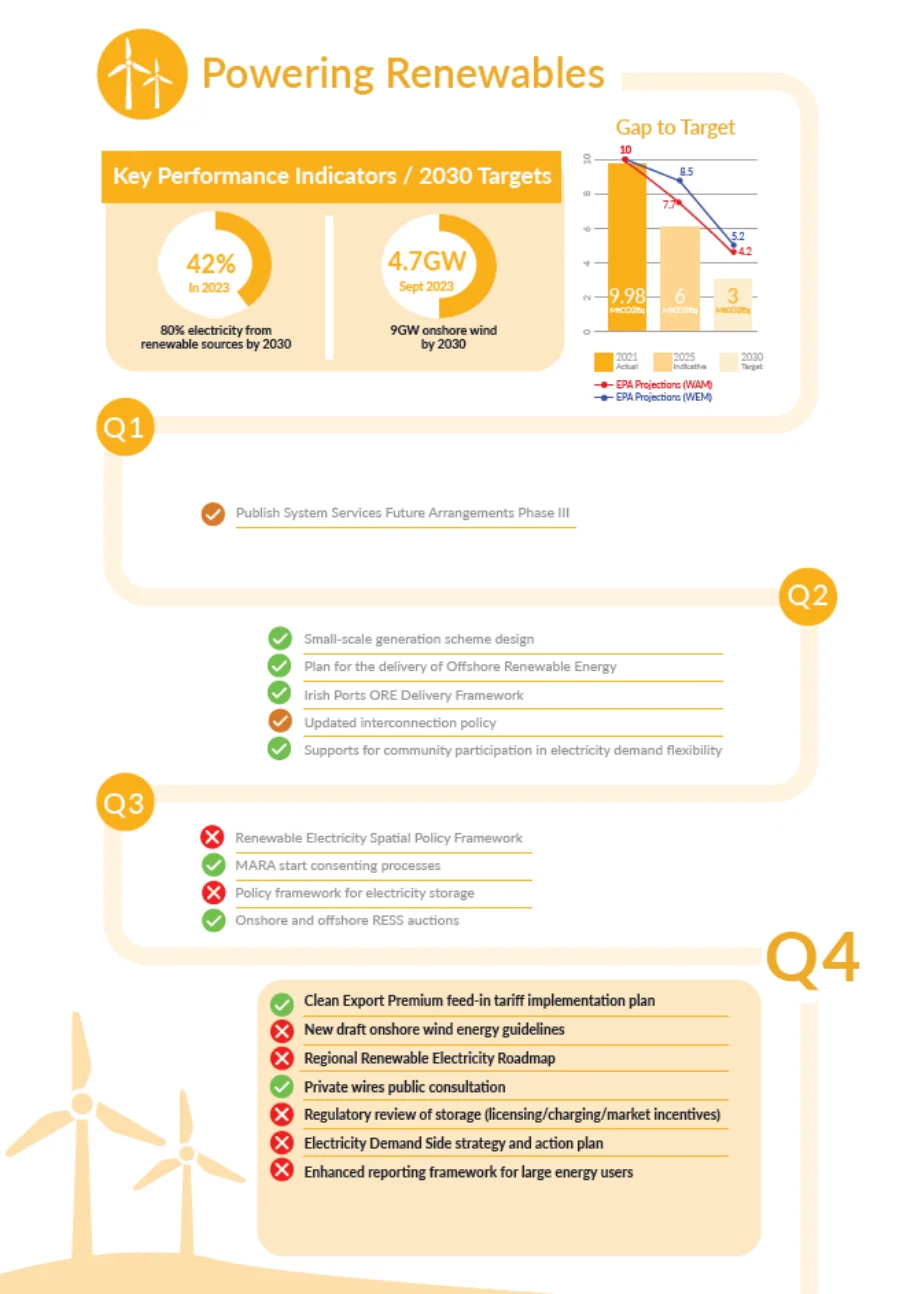
Figure from page 20
| High Impact Action Completed in Q4 2023: Electricity | ||
| Did You Know? Currently, the Electricity Supply Board (ESB) owns the national grid | ||
| infrastructure in Ireland. Private wires have the potential to provide off-grid solutions for | ||
| the generation and supply of electricity. If private wires are enabled, this would allow | ||
| parties other than ESB to install and own electricity infrastructure, outside the confines of | ||
| their own property, and to transmit electricity. Off-grid solutions such as private wires | ||
| may further assist in meeting our climate targets and sectoral emissions ceilings. | ||
| What’s new? In Q4 2023, DECC, under action EL/23/15, published a public | ||
| consultation on private wires. The consultation ran from 18 August to 27 October 2023. | ||
| This year DECC will publish a summary report of the consultation responses and will | ||
| develop a policy on private wires. |
| High Impact Action Delayed in Q4 2023: Electricity | ||
| Did You Know? In Q4 2023, under action EL/23/2, DECC sought to publish the | ||
| Renewable Electricity Spatial Policy Framework. The objective of this spatial policy | ||
| framework is to effectively translate national renewable electricity objectives, including | ||
| those outlined in CAP23, to the regional level and allocate spatial and generation | ||
| capacity targets. This action did not complete in Q4 2023 as planned. Regional | ||
| renewable electricity capacity targets are now proposed to be included in the review of | ||
| the National Planning Framework which is due to be brought to Government in 2024. | ||
| Why is it needed? The Renewable Electricity Spatial Policy Framework will set out the | ||
| national policy framework for onshore renewable electricity (e.g. wind and solar | ||
| infrastructure) across the country. The delay to the expansion of onshore renewable | ||
| capacity, along with the continued use of coal in electricity generation, means that | ||
| steeper emissions reductions will be required in the future to keep within established | ||
| carbon budgets and sectoral emissions ceilings. |
| High Impact Action Delayed in Q4 2023: Electricity | ||
| Did You Know? The Electricity Demand Side Strategy, mandated in CAP23 under | ||
| action EL/23/24, will consider the options on how all customer groups can bring greater | ||
| flexibility to their energy consumption. For example, this can include by changing usage | ||
| to avoid peak times thereby reducing pressure on the grid and assisting with energy | ||
| security. The Commission for Regulation of Utilities (CRU) did not complete the action in | ||
| Q4 as intended, but plan to publish their Energy Demand Strategy Package in Q1 2024. | ||
| Why is it needed? The Electricity Demand Side Strategy will help us to better match our | ||
| power usage to our renewable energy generation. The strategy will set out a Programme | ||
| of Actions which will establish the next steps towards reducing demand as well as | ||
| building a foundation for a flexible system. It will also provide guidelines for new Large | ||
| Energy User connections, such as those for data centres, to the electricity and gas | ||
| networks. This strategy will assist with decarbonisation, enhance security of supply, and | ||
| lower system costs. It will be essential in growing our economy in a sustainable manner. |
Pages 19–22 · View in original PDF