3 Transport
Share of GHGs
At 17.1%, transport was the second biggest greenhouse gas emitting
in Ireland in
sector in Ireland in 2022, experiencing the largest increase of all sectors
2022
since 1990. In its projections, the EPA estimates that emissions from
17.1%
transport will reduce by 1 - 35% between 2021 and 2030 depending on
the speed and scale of measures implemented (Figure 2).
| biofuel blends of 10% for petrol and 20% for diesel, as well as a 20% (WEM) reduction in total kilometres travelled through better land use planning and a shift from private fossil-fuelled cars to public transport, walking and cycling. Reducing transport emissions sufficiently to 2030 and 2050 will be challenging, with increased pressures from a growing population and economy as well as the potential for fluctuating fossil fuel prices. Effective (WAM) policies and actions are needed now to realise benefits in the longer term. The focus remains on the rapid implementation of high-impact actions to bank emissions savings as early as possible in cumulative carbon budgets. Otherwise, sectoral targets and the transport SEC will be breached. CAP24, published in Q4 2023 and awaiting public consultation, maintains a Figure 2 Projected focus on the “Avoid Shift Improve” framework established in CAP23, with no transport emissions to 2030 (EPA, 2023) change to the key performance indicators established for the sector. This framework emphasises the crucial role of spatial and land-use planning in designing transport systems that can support our net-zero ambition and seek to “avoid” unnecessary emissions by reducing journey times and travel demand in the first instance. Shifting journeys to public and active transport also remains key in CAP24, with an acceleration of supporting infrastructure required to provide attractive alternatives to the fossil-fuelled car. Finally, transport journeys can be improved through the electrification of passenger and commercial fleets, as well as the increased use of biofuels to lessen the fossil fuel content of petrol and diesel used. Addressing emerging challenges and risks to abatement delivery is also central to the new Transport chapter in CAP24. For example, this includes the impact of inflation on infrastructure construction costs, planning and consenting issues, public and political acceptance of required changes and ensuring market capacity and skills development. | (WEM) (WAM) |
|---|---|
| Reducing transport emissions sufficiently to 2030 and 2050 will be | |
| challenging, with increased pressures from a growing population and | |
| economy as well as the potential for fluctuating fossil fuel prices. Effective | |
| policies and actions are needed now to realise benefits in the longer term. | |
| The focus remains on the rapid implementation of high-impact actions to | |
| bank emissions savings as early as possible in cumulative carbon budgets. | |
| Otherwise, sectoral targets and the transport SEC will be breached. | |
| CAP24, published in Q4 2023 and awaiting public consultation, maintains a | |
| focus on the “Avoid Shift Improve” framework established in CAP23, with no | |
| change to the key performance indicators established for the sector. This | |
| framework emphasises the crucial role of spatial and land-use planning in designing | |
| transport systems that can support our net-zero ambition and seek to “avoid” unnecessary | |
| emissions by reducing journey times and travel demand in the first instance. | |
| Shifting journeys to public and active transport also remains key in CAP24, with an | |
| acceleration of supporting infrastructure required to provide attractive alternatives to the | |
| fossil-fuelled car. Finally, transport journeys can be improved through the electrification of | |
| passenger and commercial fleets, as well as the increased use of biofuels to lessen the | |
| fossil fuel content of petrol and diesel used. | |
| Addressing emerging challenges and risks to abatement delivery is also central to the new | |
| Transport chapter in CAP24. For example, this includes the impact of inflation on | |
| infrastructure construction costs, planning and consenting issues, public and political | |
| acceptance of required changes and ensuring market capacity and skills development. |
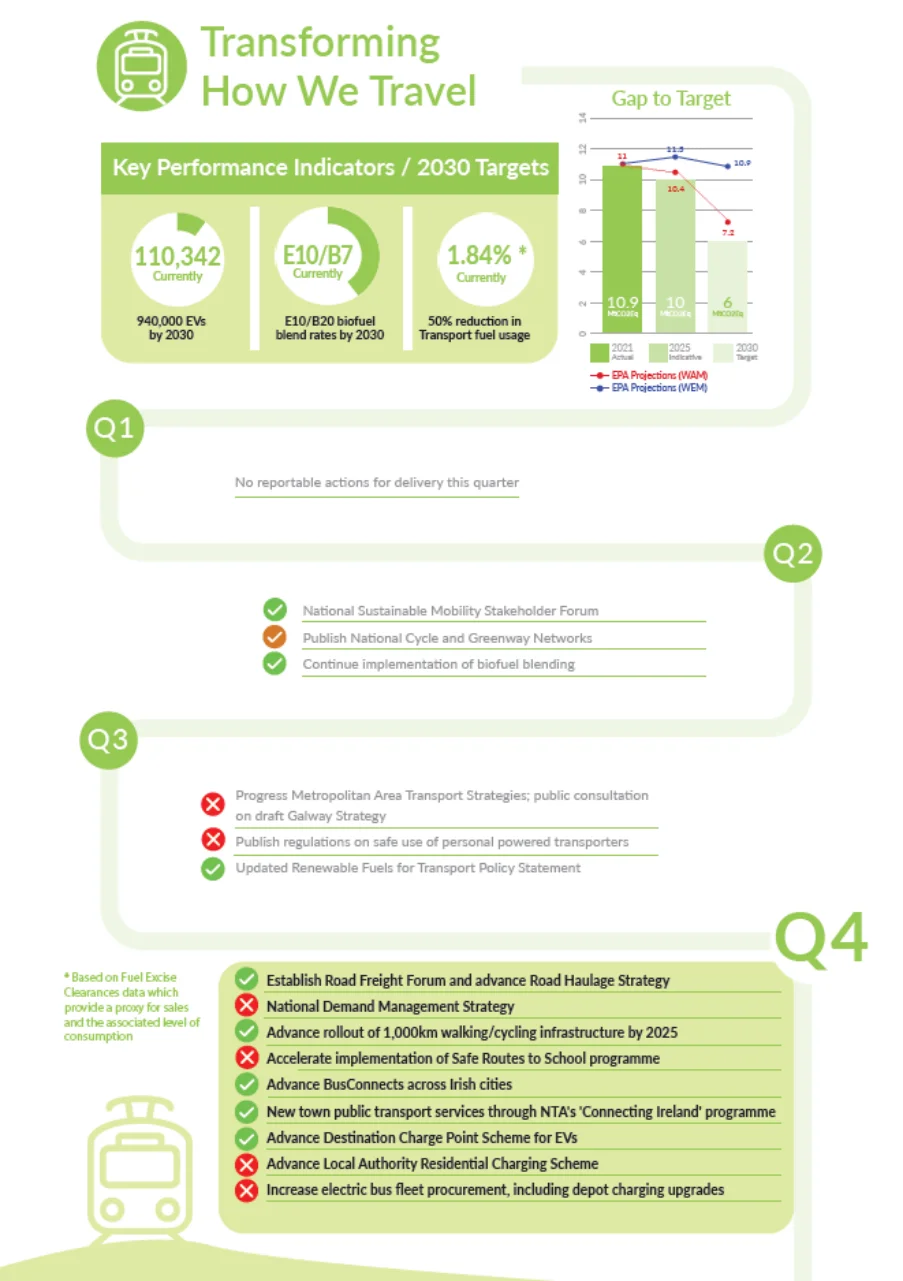
Figure from page 17
| High Impact Action Completed in Q4 2023: Transport | ||
| Did You Know? Providing more sustainable transport options for rural communities is | ||
| key to achieving emissions reductions in the transport sector. Connecting Ireland, a | ||
| major public transport initiative developed by the National Transport Authority (NTA), | ||
| prioritises public transport projects that enhance regional and rural connectivity, | ||
| improving the alternatives to private car use. | ||
| What’s new? Under Action TR/23/41(TF) in CAP23, Connecting Ireland Phase 2 | ||
| introduced 24 new and 41 enhanced public transport services connecting approximately | ||
| 194 towns nationwide. 94% of Carlow town’s population is now within an 800-metre walk | ||
| of a bus stop on the new town service network. In addition, the new Clonmel town | ||
| service launched in December 2023 and has supported over 10,000 passenger journeys | ||
| in its first month of operation. This expansion and increased frequency of public transport | ||
| services in rural Ireland is an essential step towards the reduction in fossil-fuelled vehicle | ||
| kilometres travelled by private cars. |
| High Impact Action Delayed in Q4 2023: Transport | ||
| Did You Know? Under Action TR/23/19 in CAP23, a National Demand Management | ||
| Strategy (DMS) was due to publish in Q4 2023. Strategy development is at an advanced | ||
| stage, with a draft expected to be submitted to Government for approval to publish for | ||
| public consultation in Q1 2024. | ||
| Why is it needed? Our travel preferences are deeply embedded through settlement | ||
| patterns, policies, and mindsets, often favouring private car usage over more sustainable | ||
| transport modes. Accounting for a rising population, the DMS will consider approaches to | ||
| reducing traffic congestion and improving access to public transport. Encouraging | ||
| individuals to make a shift in how they travel provides benefits in terms of health, air | ||
| quality, reduced noise pollution, and improved placemaking, as well as reducing | ||
| emissions. As per CAP23, the DMS will be a key driver of the reforms needed to meet | ||
| our 2030 targets of reducing the total distance driven across all car journeys by 20%, | ||
| and for walking, cycling and public transport to account for 50% of our journeys. |
Pages 16–18 · View in original PDF