2 Agriculture
Share of GHGs
Agriculture is the largest greenhouse gas (GHG) emitting sector in Ireland,
in Ireland in
responsible for 34.3% of national emissions in 2022. Methane, largely from
2022
producing beef and dairy, is the biggest sectoral source, accounting for
34.3%
c.68% of Irish agricultural GHGs. When combined with additional
agriculture-related emissions from organic soils drained for farming uses
(grasslands) currently accounted for in LULUCF, agricultural activity
| (WEM) (WAM) | ||
|---|---|---|
| Figure 1 Projected Agriculture emissions to 2030 (EPA, 2023) |
accounts for c.42% of total Irish emissions.
In the EPA projections, agriculture emissions are projected to decrease by 4
- 20% between 2021 and 2030 (Figure 1) depending on the level of policies
and interventions implemented. Emissions reductions are projected from
fertiliser switching, limits on fertiliser use and bovine feed additives. Sectoral
targets for 2030 and the agriculture SEC are nevertheless expected to be
breached, even with full implementation of current planned measures.
Livestock diversification measures proposed in CAP23 were not included in
the EPA projections due to a lack of a clear implementation pathway,
signalling an urgency for policy elaboration in this area. There is also a need,
as with all sectors, to move measures from currently ‘planned’ (WAM) to
‘being implemented’ (WEM) to ensure their impact as quickly as possible as
part of cumulative carbon budgets. This can be achieved by firming up policy
delivery pathways and providing relevant support and clarity to farmers on
action to be taken (e.g. timelines, resourcing, incentives, disincentives etc).
In the stocktake of abatement progress published as part of the draft CAP24, although
agricultural emissions decreased by 1.4% between 2021 and 2022, they are still reported to
have been higher than the proposed pathway outlined in CAP23. The sector now needs to
reduce emissions by, on average, 8.3% annually for 2023, 2024 and 2025 to remain within
the first carbon budget allocation.
CAP24 commits to implement specific and targeted actions to drive the delivery of
abatement KPIs in the sector. It also commits to devise new required actions, in
collaboration with stakeholders, drawing on insights from the Teagasc Marginal Abatement
Cost Curve (MACC) that published in July 2023 as well as innovations from Climate-KIC’s
“Deep Demonstration” on the Irish agri-food and biobased value chain.
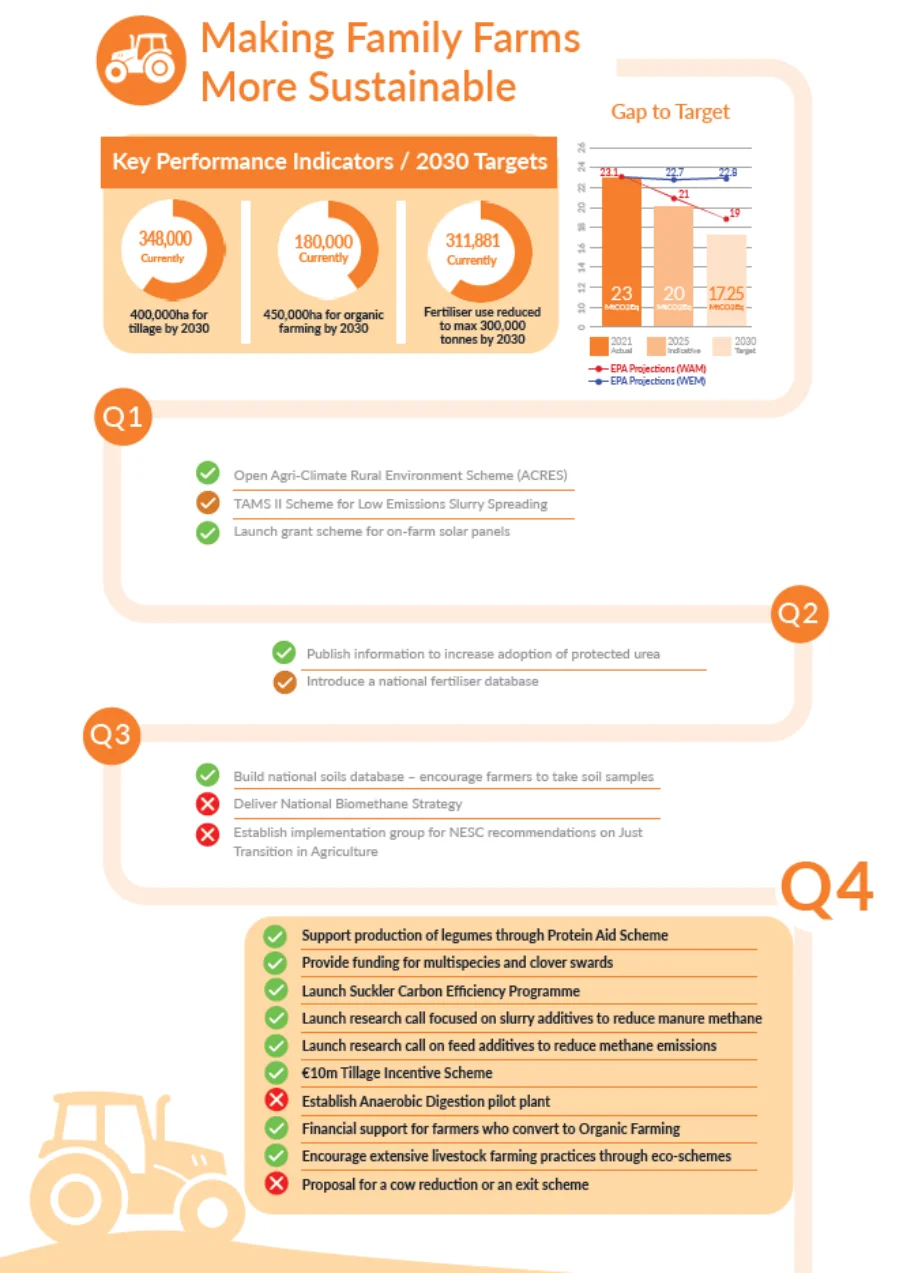
Figure from page 13
| High Impact Action Completed in Q4 2023: Agriculture | ||
| Did You Know? Climate action advisory services to farmers are essential to transfer | ||
| knowledge and skills from national research and policy to action on the ground. | ||
| Supporting farmers with the right information, demonstration farms, data and online tools | ||
| can help to build capacity for the implementation of climate action in the sector. | ||
| What’s new? Under Action RE/23/1/A in CAP23, Teagasc has established a Signpost | ||
| Advisory Programme, with 21 Climate Advisors now actively engaging with farmers | ||
| throughout the country. By the end of October, over 7,000 farmers had signed up to | ||
| participate in this new advisory programme through 420 workshops. A new sustainability | ||
| digital platform (AgNav) has also launched and is operating as a closed pilot for Bord Bia | ||
| Quality Assured beef and dairy farmers. This tool will help individual farmers engage with | ||
| the emissions profile for their farm and plan necessary actions to reduce them. |
| High Impact Action Delayed in Q4 2023: Agriculture | ||
| Did You Know? Under Action AG/23/13, DAFM were due to deliver Ireland’s first | ||
| National Biomethane Strategy in Q3 2023. This action remained delayed in Q4 2023. It | ||
| was published for public consultation at the end of January, ahead of consideration of | ||
| the Plan by Government to allow for its finalisation. | ||
| Why is it needed? Biomethane provides an income and land use diversification | ||
| opportunity for farmers by using grass and other farm wastes (e.g. slurry) to produce | ||
| renewable gas. A national strategy will help to identify actionable recommendations to | ||
| stimulate a biomethane industry in Ireland and mobilise the 5.7 TWh target established | ||
| in CAP23. With the aim of leading to voluntary reductions in livestock numbers on farm, | ||
| biomethane, in turn, will also provide for emissions reductions in the transport and | ||
| industry sectors as fossil fuels are displaced. |
| High Impact Action Delayed in Q4 2023: Agriculture | ||
| Did You Know? Under Action AG/23/10, DAFM were due to publish a proposal for a | ||
| cow reduction or an exit scheme. It did not complete in Q4 2023 and will carry forward | ||
| for delivery and reporting under CAP24 as a high impact action for the sector. | ||
| Why is it needed? The need for diversification options for livestock farmers to achieve | ||
| required emissions reductions in agriculture was recognised in CAP23. The Plan also | ||
| recognised that, to have an impact, any voluntary herd reduction must be structured in a | ||
| way that ensures that reductions in breeding ruminants on one farm are not offset by | ||
| increases in overall breeding ruminant numbers (i.e. more cows on other farms). The | ||
| careful design of any cow reduction or exit scheme would be key to achieving this | ||
| objective. The completion of this action is also among the recommendations of the Food | ||
| Vision sectoral groupings to provide a further emissions reduction option to farmers. |
Pages 12–15 · View in original PDF