7 Industry
Share of GHGs
Industrial emissions accounted for 9.7% of Ireland’s total emissions in
in Ireland in
2022, with manufacturing combustion and industrial processes as the
2022
key emissions sources. These emissions are largely affected by cement
9.7%
production in Ireland, with emissions increasing, for example, in times
of economic boom and when Covid-19 restrictions relaxed.
This quarter, the EPA projects that manufacturing combustion emissions will
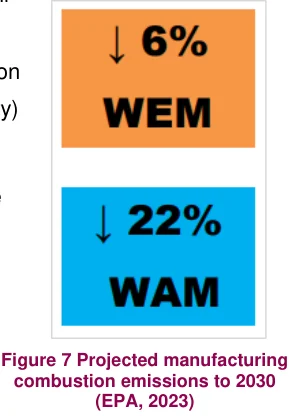
Figure from page 26
reduce by 6 - 22% from 2021 to 2030 with the implementation of efficiency
measures and renewable heat generation in industry. The full implementation
of biomethane targets (with use split across heating in buildings and industry)
is also required to meet the upper end of this range.
Meanwhile, process emissions are projected to increase by 5% in the same
time period under the EPA’s WEM scenario due to anticipated increased
cement production. There is no WAM scenario for process emissions as no
additional measures are yet identified to address them.
The EPA were unable to model the full CAP23 targets for renewable
Figure 7 Projected manufacturing
combustion emissions to 2030
heating in industry nor measures aimed at decreasing embodied carbon
(EPA, 2023)
in construction materials due to unclear implementation pathways. The use of Carbon
Capture and Storage in industry post-2030 was also not included for the same reason. The
industry SEC is thus expected to be breached by quite a significant margin according to the
EPA, without better defined emissions reducing pathways.
Recommendations from the CCAC Annual Review 2023 this quarter include the need for the
decarbonisation roadmap for industrial heat to be delivered by Q4 2023 to provide clear
signals for industry. Government is also recommended to find ways to help industry to
become more energy efficient and less reliant on fossil fuels. Efforts to reduce the emissions
intensity of cement and concrete used in construction are also required. The CCAC also
recommends an urgent update to building regulations to increase the use of timber in
construction and also encourage greater usage of lower carbon cement and concrete.
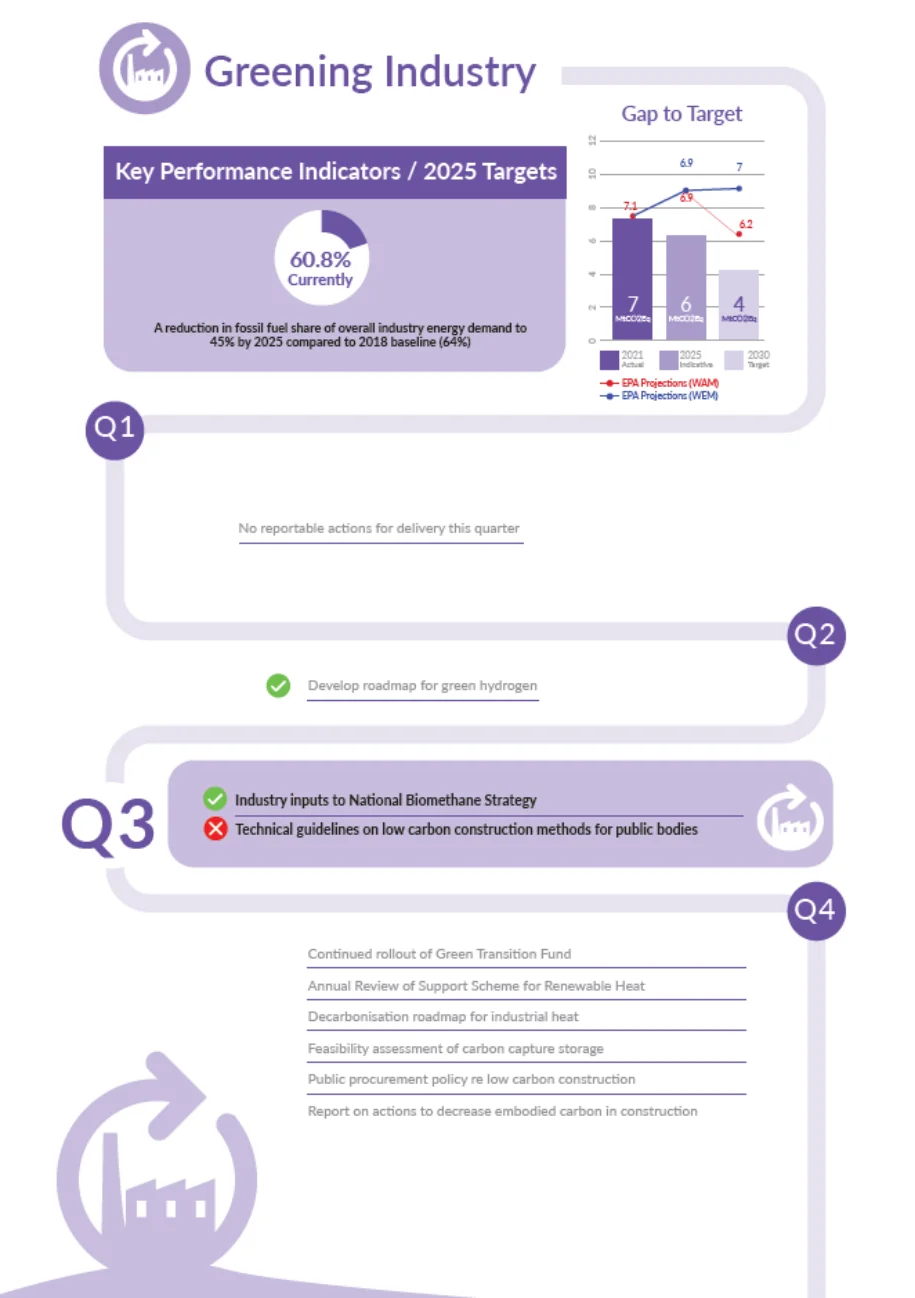
Figure from page 27
| High Impact Action Delayed in Q3 2023: Industry | ||
| Did You Know? As we increasingly consider the carbon embodied in construction | ||
| materials, the demand for low carbon building materials is increasing. Producers, | ||
| including cement manufacturers, can implement changes to their production processes | ||
| and mix designs to create a lower carbon alternative to traditional materials. | ||
| What’s new? A recommendation was due to Cabinet in Q3 specifying low carbon | ||
| construction methods and low carbon cement material, as far as practicable, for directly | ||
| procured or supported construction projects from 2023. This is an important part of the | ||
| public sector leading by example in low carbon construction methods, but the action was | ||
| delayed in Q3. DETE successfully secured expert services in May and a study is being | ||
| produced to inform policy on the procurement of low carbon cement material. Results | ||
| from this study will inform recommendations that will be brought to Government. |
| High Impact Action Delayed in Q3 2023: Commercial Buildings | ||
| Did You Know? CAP23 sets out our level of ambition for decarbonising commercial | ||
| buildings and a detailed roadmap is being developed to guide this process. While this | ||
| action rests under the SEC for buildings, it has important implications for businesses | ||
| across Ireland. The roadmap aims to set out the key existing and new policy | ||
| interventions to support and reduce emissions from the commercial sector. It will set out | ||
| the standards, regulations and timelines that will help drive the necessary changes in | ||
| heating and energy systems. | ||
| What’s new? Drafting of the Commercial Built Environment Roadmap is currently being | ||
| finalised by the relevant working group, following detailed stakeholder engagement. | ||
| Once a final draft is agreed by the working group, it will be presented for discussion by | ||
| the Heat and Built Environment Taskforce before being submitted to Government for | ||
| information in advance of publication. Drafting and publication will be closely aligned with | ||
| other policy documents due imminently regarding public sector buildings | ||
| decarbonisation, district heating and broader heat policy decisions, and the sequence of | ||
| these publications may influence the exact timing for delivery of this roadmap. |
Pages 26–28 · View in original PDF