6 Land Use, Land Use Change and Forestry
Using current estimates, land uses emitted c.7.3Mt CO2 eq in 2022, more
Share of GHGs
than the emissions from residential buildings. The Land Use, Land Use
in Ireland in
Change and Forestry (LULUCF) sector has been an emissions source in
2022
Ireland since 1990 and has a challenging profile for future emissions
10.7%
creation. Science continues to evolve to better estimate emissions from
the sector, which may lead to future inventory changes.
The main emissions source reported in 2021 in LULUCF was from
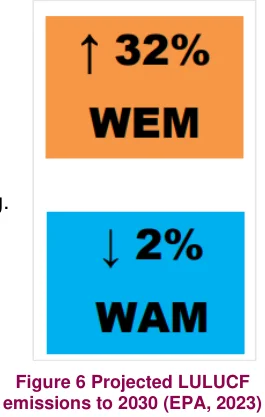
Figure from page 23
grasslands on drained organic soil (e.g. used for grazing cattle). Despite
currently representing only c.8% of grasslands, they were responsible for
over 80% of reported emissions from drained peatlands (excluding forested
peatlands).
Forestry on peat soils also creates emissions, as do degraded wetlands (e.g.
bogs drained for peat extraction). These emissions sources are offset
somewhat by removals of CO2 through forests on mineral soils, active (wet)
bogs and Harvested Wood Products which can act as carbon sinks.
The EPA projects that emissions from LULUCF will increase to 2030 as
Figure 6 Projected LULUCF emissions to 2030 (EPA, 2023)
our forestry reaches harvesting age and changes to a carbon source.
Planned policies and measures can reduce the extent of the emissions increase, highlighting
the importance of rapidly increasing tree planting, managing the water table on agricultural
organic soils and rehabilitating peatland to revert current emissions sources to net sinks.
A key recommendation from the CCAC Annual Review published in Q3 2023 for the
LULUCF sector concerns the need for a streamlined process for applications to the new
forestry scheme that also launched in Q3. This, the Council reiterates, will be needed to
ensure speedy implementation of new tree planting measures. The issue of forestry on
drained peatlands (an emissions source) is also addressed by the CCAC, who call for
resources and practical guidance for landowners to best manage these areas, including
options for rewetting and rehabilitation. This will help to enhance their carbon storage
capacity and resilience to climate change. The extraction of peat for horticulture is noted as
unsustainable and must also cease according to the Council recommendations, with a need
for accelerated research and development to identify alternative sustainable horticultural
substrates.
| High Impact Action Completed in Q3 2023: LULUCF | ||
| Did You Know? Trees planted on mineral soils act as essential carbon sinks by | ||
| absorbing CO from the atmosphere as they grow through photosynthesis. The larger the 2 | ||
| tree, the more CO that is absorbed. Increasing forestry cover in Ireland is therefore an 2 | ||
| essential part of meeting climate neutrality targets by 2050 and will help to offset residual | ||
| emissions in other sectors. CAP23 re-committed to targets of at least 8,000ha of tree | ||
| planting per annum, with a new forestry strategy and programme of supports essential to | ||
| achieving this goal to address recent low planting rates. | ||
| What’s new? The €1.3bn Forestry Programme 2023-2027, delayed from Q2, has now | ||
| been approved by the European Commission and the Strategic Environmental | ||
| Assessment and Appropriate Assessment process completed. It was formally launched | ||
| in Q3 under Action LU/23/1. The programme introduces new forest creation and | ||
| management measures, as well as increased generous financial supports for farmers | ||
| and landowners to support more tree planting. Schemes are now open for applications | ||
| and a series of promotional events are taking place across the country to encourage | ||
| participation. For more information, please see here. |
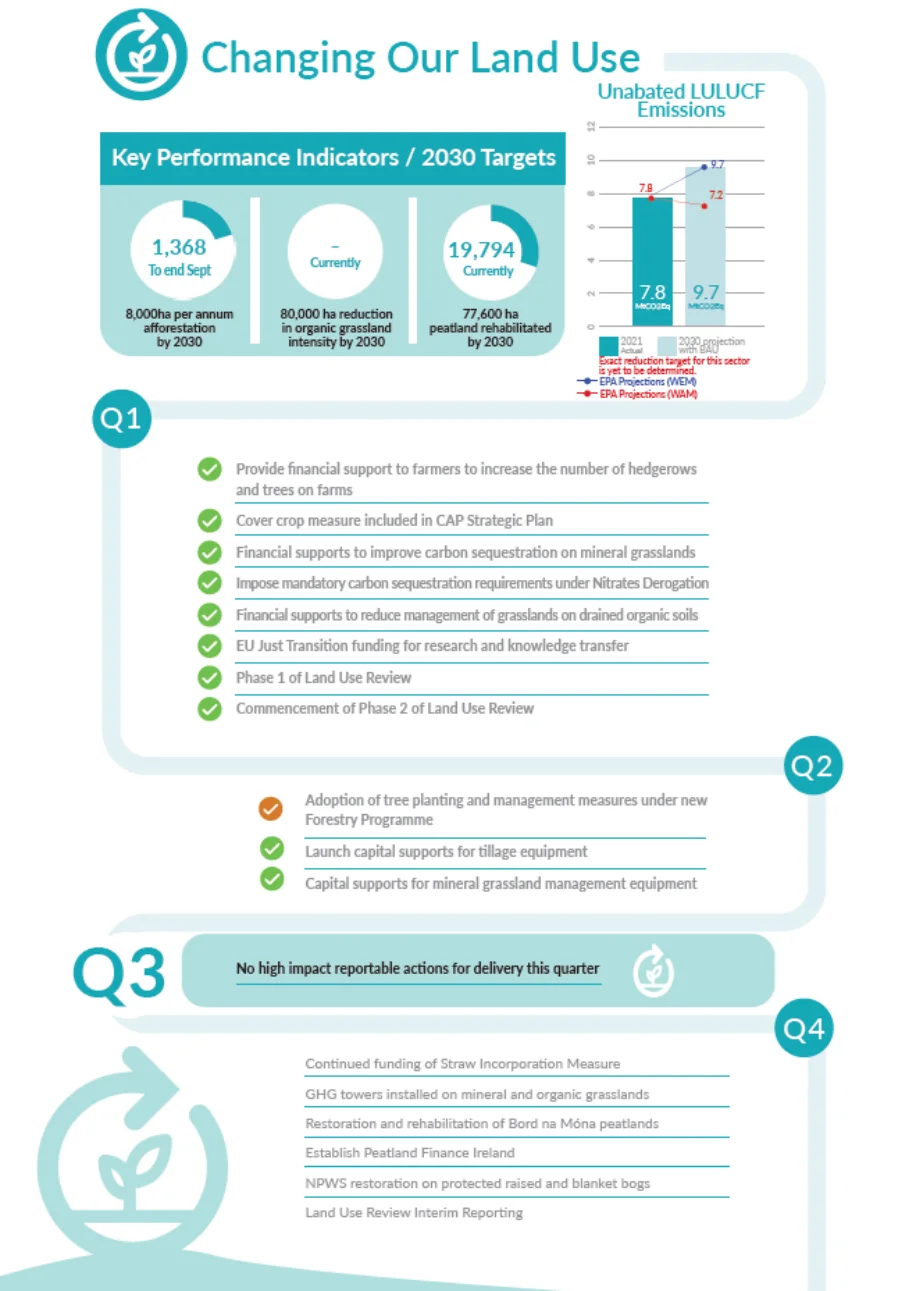
Figure from page 25
Pages 23–25 · View in original PDF