2 Agriculture
Share of GHGs
Agriculture is the largest GHG emitting sector in Ireland, directly
in Ireland in
responsible for 34.3% of national emissions. Methane from raising
2022
livestock is the biggest sectoral source, accounting for c.68% of these
34.3%
GHGs. When combined with additional agriculture-related emissions from
organic soils drained for farming uses (grasslands) currently accounted for
in LULUCF, agricultural activity combined accounts for c.45% of Irish
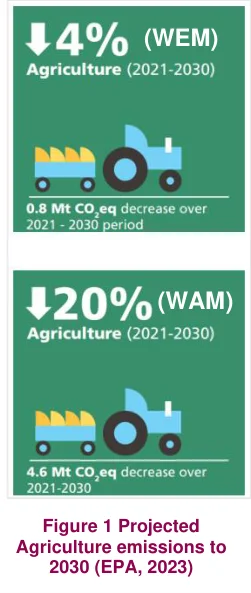
Figure from page 10
emissions.
(WEM)
In the most recent EPA projections, emissions from agriculture are projected
to decrease by 4 - 20% between 2021 and 2030 (Figure 1) depending on the
level of policies and interventions implemented. Emissions reductions are
projected from the likes of fertiliser switching, limits on fertiliser use and
bovine feed additives. Sectoral targets for 2030 and the agriculture SEC are
nevertheless expected to be breached, even with full implementation of
(WAM)
current planned measures.
Livestock diversification measures proposed in CAP23 were not included in
the recent EPA analysis due to a lack of a clear implementation pathway,
signalling an urgency for policy elaboration in this area.
There is also a need, as with all sectors, to move measures from currently
‘planned’ (WAM) to ‘being implemented’ (WEM) to ensure their impact as
Figure 1 Projected Agriculture emissions to
quickly as possible as part of carbon budget considerations. This can be
2030 (EPA, 2023)
achieved by firming up policy delivery pathways and providing relevant
support and clarity to farmers (e.g. timelines, resourcing, incentives, disincentives etc).
In its Annual Review published in Q3, the CCAC placed emphasis on Government actively
supporting income diversification opportunities for farmers, including payments for
ecosystem services. The rapid uptake of proven and effective mitigation measures from the
Teagasc 2023 MACC is also recommended across the sector. Government is also advised
to ensure sufficient supplies of greener forms of fertiliser and to communicate to farmers as
such. Finally, the CCAC recommend urgent consideration of the roll out of feed additives for
dairy farms to reduce methane emissions from cattle.
Figure from page 11
| High Impact Action Completed in Q3 2023: Agriculture | ||
| Did You Know? Reduced nitrogen fertiliser use and fertiliser switching represent key | ||
| actions for emissions reductions in agriculture under CAP23. A National Fertiliser | ||
| Database can work to track fertiliser sales more accurately, helping to monitor the impact | ||
| and success of any interventions implemented. | ||
| What’s new? While originally due in Q2, a National Fertiliser Database has since been | ||
| established under Action AG/23/1 in Q3 2023. It is now a requirement, under recently | ||
| established legislation, to be registered with DAFM and placed on the Database to sell or | ||
| purchase fertiliser in Ireland. This requirement will help to provide a more realistic picture | ||
| of where fertiliser is applied to land, minimise reporting requirements for farmers and | ||
| facilitate timely farmer payments under established eco-schemes. Over 110,000 farmers | ||
| have registered to date. For more information, please see here. |
| High Impact Action Delayed in Q3 2023: Agriculture | ||
| Did You Know? Under Action AG/23/13, DAFM were due to deliver Ireland’s first | ||
| National Biomethane Strategy. A dedicated working group has been meeting monthly to | ||
| progress this action, but it failed to complete on time in Q3. Through extensive | ||
| consultation, the Strategy aims to identity actionable recommendations to stimulate a | ||
| biomethane industry in Ireland and mobilise the 5.7 TWh target established in CAP23. | ||
| The Strategy is close to finalisation and is expected to publish in Q4. | ||
| Why is it needed? Biomethane provides an income and land use diversification | ||
| opportunity for farmers by using grass and other farm wastes (e.g. slurry) to produce | ||
| renewable gas. The development of anaerobic digestion and a biomethane industry in | ||
| Ireland is an essential part of the diversification package proposed for livestock farmers | ||
| in CAP23, with the intention of leading to voluntary reductions in herd numbers. The | ||
| renewable energy produced will, in turn, provide for emissions reductions in the transport | ||
| and industry sectors as fossil fuels are displaced. This highlights the valued contribution | ||
| that farmers can make not only to emissions reduction in agriculture, but in the | ||
| decarbonisation of Ireland’s energy system. |
Pages 10–12 · View in original PDF