6 Land Use, Land Use Change and Forestry
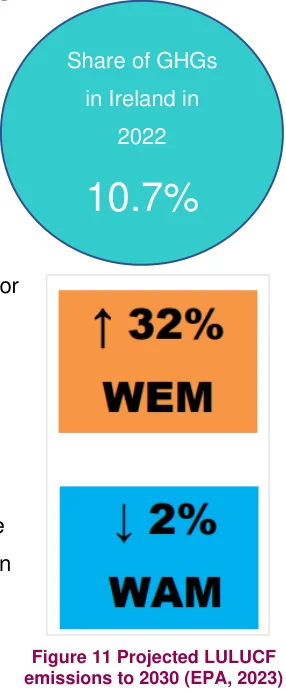
Figure from page 23
Land Use, Land Use Change and Forestry (LULUCF) has been an
Share of GHGs
emissions source in Ireland since 1990. Using current emissions factor
in Ireland in
estimates, land uses emitted c.7.3Mt CO2 eq in 2022, more than the
2022
emissions from residential buildings.
10.7%
The main emissions source reported in 2021 in LULUCF was from
grasslands on drained organic soil (e.g. used for grazing cattle). Despite
only representing c.8% of grasslands in the country, they were responsible for
over 80% of reported emissions from drained peatlands (excluding forested
peatlands). Science continues to evolve to better estimate and understand
emissions from the LULUCF sector, which may lead to inventory changes in
the future.
Forestry on organic / peat soils can also create emissions, as can degraded
wetlands (e.g. bogs that have been drained for peat extraction). Sources are
offset somewhat by removals of CO2 from the atmosphere through forests on
mineral soils, active (wet) bogs and Harvested Wood Products.
In the EPA projections, emissions from LULUCF are predicted to increase
Figure 11 Projected LULUCF emissions to 2030 (EPA, 2023)
to 2030 as our forestry reaches harvesting age and changes to a carbon
source. Planned policies and measures are projected to reduce the extent of the emissions
increase. The EPA highlights the importance of increased afforestation, water table
management on agricultural organic soils and peatland rehabilitation to revert current
emissions sources to net sinks and to counteract the impact of expected forest harvesting.
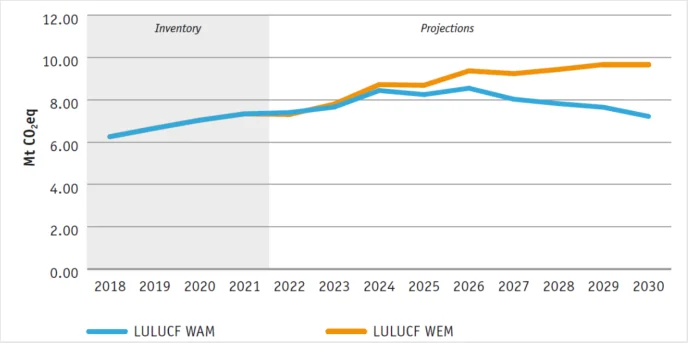
Figure 12 Emissions projections for LULUCF, 2018 - 2030 (EPA, 2023)
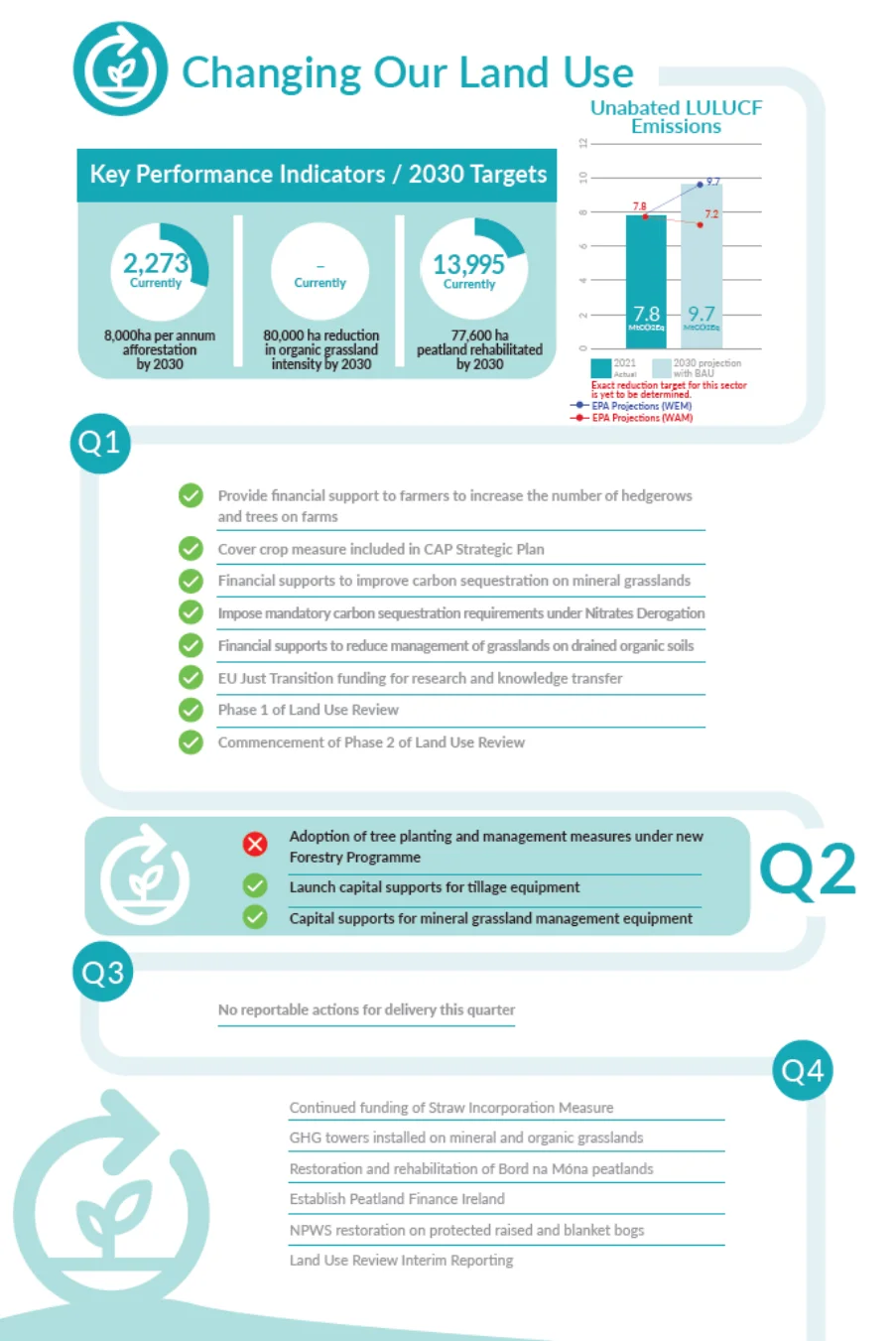
Figure from page 24
| High Impact Action Completed in Q2 2023: LULUCF | ||
| Did You Know? As detailed in the Agriculture chapter, TAMS provide grants to farmers | ||
| to help build and/or improve farm buildings and equipment, supporting climate action at | ||
| farm level. The improved management of grasslands on mineral soils is an area jointly | ||
| targeted by TAMS and CAP23. Soil type matters when it comes to determining if a | ||
| grassland acts as a sink or source of emissions. Grasslands on mineral soils, which | ||
| constitute 92% of grasslands, are currently estimated to sequester c.2Mt of carbon, | ||
| acting as an important sink to partially offset emissions sources elsewhere, including | ||
| from grasslands on organic soils. | ||
| What’s new? A range of pasture management equipment have now been included in | ||
| the TAMS 3 investment list under Action LU/23/7A (e.g. soil aerators, mulchers, GPS | ||
| fertiliser application and Precision Grass Measuring Equipment). These investments | ||
| contribute to more efficient management of mineral soil grasslands which can improve | ||
| carbon sequestration. This includes by avoiding soil compaction, increasing reseeding | ||
| interval (thereby reducing the need for ploughing), the inclusion of clover/legumes to | ||
| reduce fertiliser dependence and overall improving the efficiency of production. |
| High Impact Action Delayed in Q2 2023: LULUCF | ||
| Did You Know? A new €1.3bn Forestry Programme 2023-2027 as due to be adopted | ||
| and launched in Q2 2023 under Action LU/23/1. It has been delayed subject to State Aid | ||
| approval from the EU Commission, which was formally submitted to in April 2023. The | ||
| Programme also remains subject to an ongoing Strategic Environmental Assessment. | ||
| Why is it needed? The new Forestry Programme will introduce new afforestation | ||
| measures and increased financial supports to incentivise tree planting. Its adoption is | ||
| critical to allow landowners and farmers access to the generous supports available and | ||
| put us on a trajectory to increasing planting rates to at least 8,000ha/annum. Without it, | ||
| new afforestation licence applications remain considerably low, with only 133ha so far | ||
| afforested in 2023 according to the DAFM Forestry Dashboard. Further delays therefore | ||
| place afforestation targets and longer-term climate neutrality in jeopardy. |
Pages 23–25 · View in original PDF