5 Buildings
Share of GHGs
Emissions from buildings, including homes, commercial premises and
in Ireland in
public buildings, made up 11.1% of Ireland’s emissions in 2022. Most of
2022
this (9%) was from residential buildings. Energy prices, average yearly
11.1%
temperatures, energy efficiency measures, fuel switching and remote
working have all influenced emissions from buildings of late.
In the recent EPA projections, emissions from residential buildings are set to
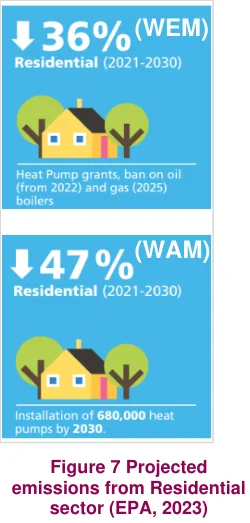
Figure from page 19
(WEM)
decrease by 36 - 47% between 2021 and 2030 (Figures 7 and 8). The higher
reduction level assumes, among other actions, a ban on oil and gas boilers in
new dwellings, the installation of 680,000 heat pumps, the continued rollout of
household retrofit activity including 500,000 B2 retrofits//cost optimal
equivalents, and the implementation of full district heating and biomethane
targets to decarbonise heating sources.
(WAM)
In percentage terms, with full implementation of ambitious CAP23 measures,
residential and commercial buildings are the only sectors expected to meet
emissions reduction targets for 2030. Cumulative emissions however mean
that the commercial buildings SEC will be breached, though the residential
SEC is projected to remain within limits in the second carbon budget period.
Figure 7 Projected emissions from Residential
For Commercial and Public Services, a decrease of 19 - 49% is projected
sector (EPA, 2023)
(Figures 9 and 10). Accelerated retrofitting of both public and commercial
buildings is required, along with district heating and biomethane use.
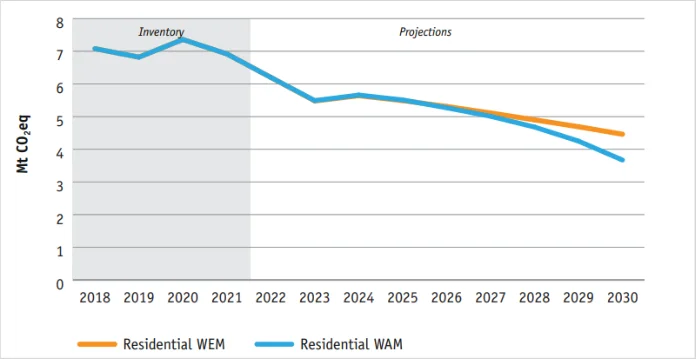
Figure 8 Emissions projections for Residential sector, 2018 - 2030 (EPA, 2023)
| Figure 9 Projected emissions from Commercial and Public Services (EPA, 2023) |
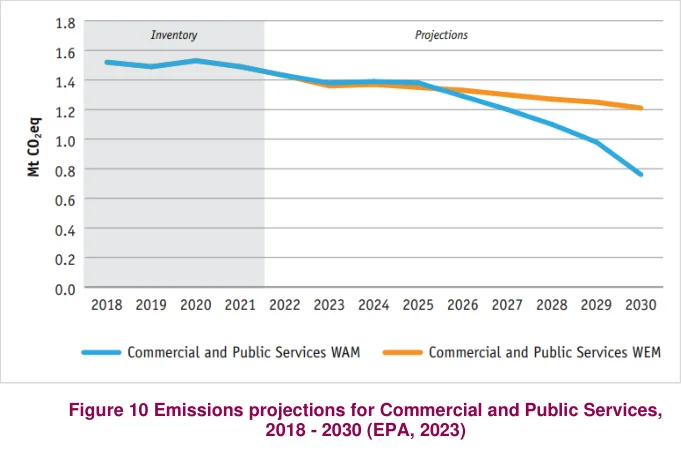
Figure from page 20
Figure 10 Emissions projections for Commercial and Public Services,
2018 - 2030 (EPA, 2023)
| High Impact Action Completed in Q2 2023: Buildings | ||
| Did You Know? The National Retrofit Plan sets ambitious targets to improve energy use | ||
| in Irish housing and reduce residential sector emissions. Retrofitting will also improve the | ||
| health and comfort of a home and reduce energy bills. However, it requires significant | ||
| investment from both homeowners and the State to do this. This can be a challenge, | ||
| particularly with the national target of upgrading at least 500,000 homes by 2030. | ||
| What’s new? A “net of grant” option is now in place for homeowners under Action | ||
| BE/23/5/A. Under the grant scheme for individual home energy upgrades (e.g. attic | ||
| insulation, heating controls, solar panels) homeowners can assign the grant payment to | ||
| their registered contractor, allowing the homeowner to only pay the balance of | ||
| installation costs. Under the National Home Energy Upgrade scheme for upgrades to B2 | ||
| (multiple energy upgrades in one go), One Stop Shop contractors will discount the grant | ||
| from the total works for the homeowner. This action will make retrofitting more accessible | ||
| as homeowners will not be required to pay the entire upfront cost. |
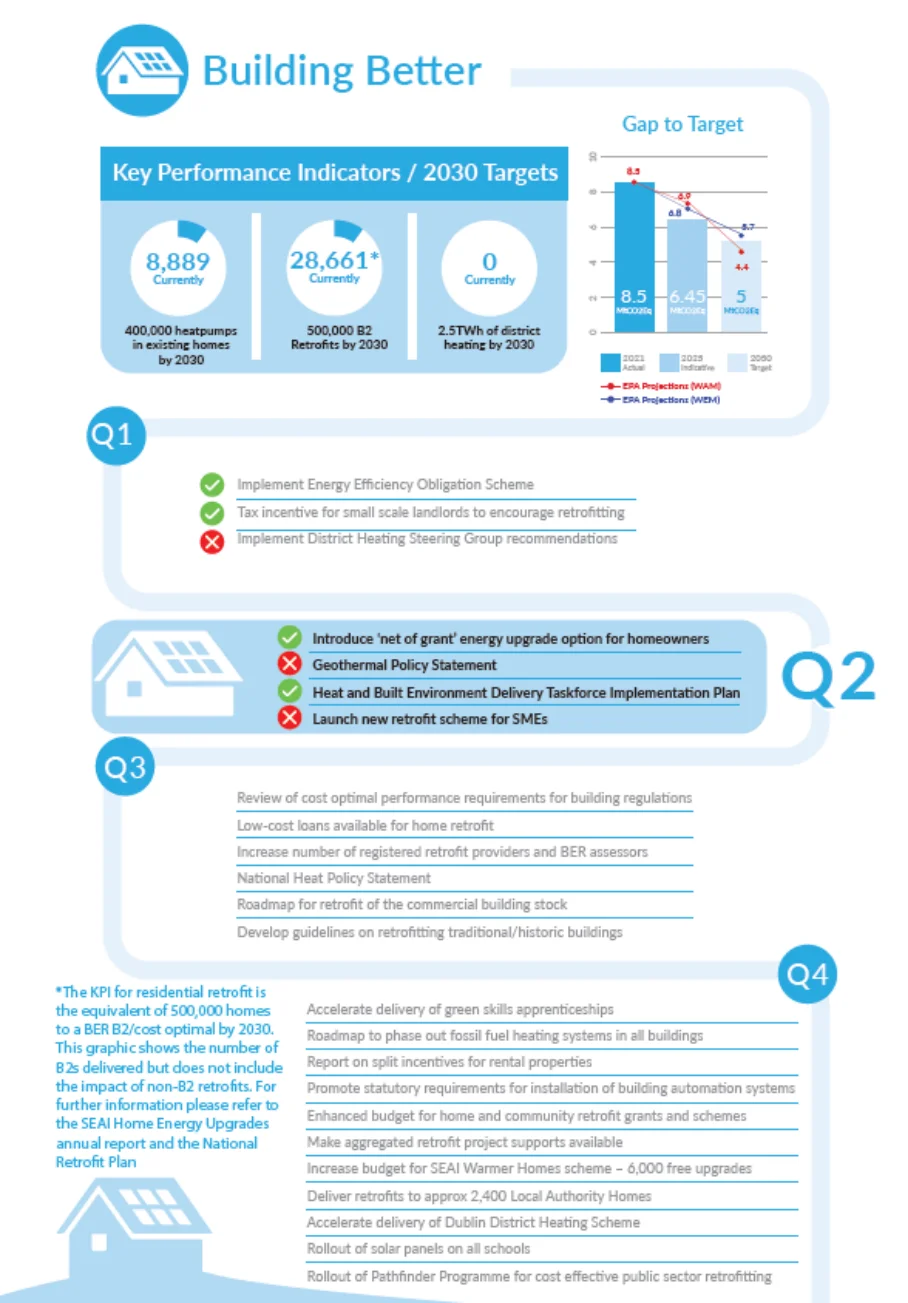
Figure from page 21
| High Impact Action Delayed in Q2 2023: Buildings | ||
| Did You Know? Action BE/23/31/B under CAP 23 aimed to launch a new non-domestic | ||
| retrofit scheme aimed at small- and medium- sized enterprises (SMEs) to provide a | ||
| tailored pathway to support retrofit activity in local businesses. This action has been | ||
| delayed for Q2 due to the IT support system for the scheme not being complete on time. | ||
| Why is it needed? There are currently a variety of supports for businesses in retrofitting | ||
| their premises and moving away from fossil fuel-based heating e.g., through funding and | ||
| services such as energy audits, technical support, training, and advice. However, given | ||
| the increased climate action ambitions in the buildings sector (and all sectors), more | ||
| targeted schemes will be required to meet 2030 emissions reduction targets as this | ||
| action could help support. |
Pages 19–22 · View in original PDF