3 Transport
Share of GHGs
Transport is the second biggest greenhouse gas emitting sector in
in Ireland in
Ireland, accounting for 17.1% of GHGs in 2022. Transport emissions
2022
overall have had the largest increase of all sectors since 1990.
17.1%
In its projections (Figures 3 and 4), the EPA estimates that emissions
from transport will reduce by 1 - 35% between 2021 and 2030 depending
on the range of measures implemented. As targeted in CAP23, the upper
(WEM)
limit includes almost 1 million electric vehicles on the road, biofuel blends of
up to 10% for petrol and 20% for diesel, as well as a 20% reduction in total
kilometres travelled through better land use planning and modal shift from
private fossil-fuelled cars to public transport, walking and cycling.
Transport in Ireland will require a multi-faceted approach to reduce emissions
(WAM)
sufficiently to 2030 and 2050. Challenges remain, including pressures from a
growing population as well as the potential for low fossil fuel prices. Transport
is also still closely coupled with economic growth, with the EPA foreseeing
increased freight emissions in the future without corrective action.
The EPA was able to model all proposed decarbonisation measures for
Transport, though sectoral targets and the transport SEC are still expected to
Figure 3 Projected transport emissions to
be breached. The focus remains on rapid implementation to bank emissions
2030 (EPA, 2023)
savings as early as possible.
Figure 4 Emissions projections for Transport, 2018 - 2030 (EPA, 2023)
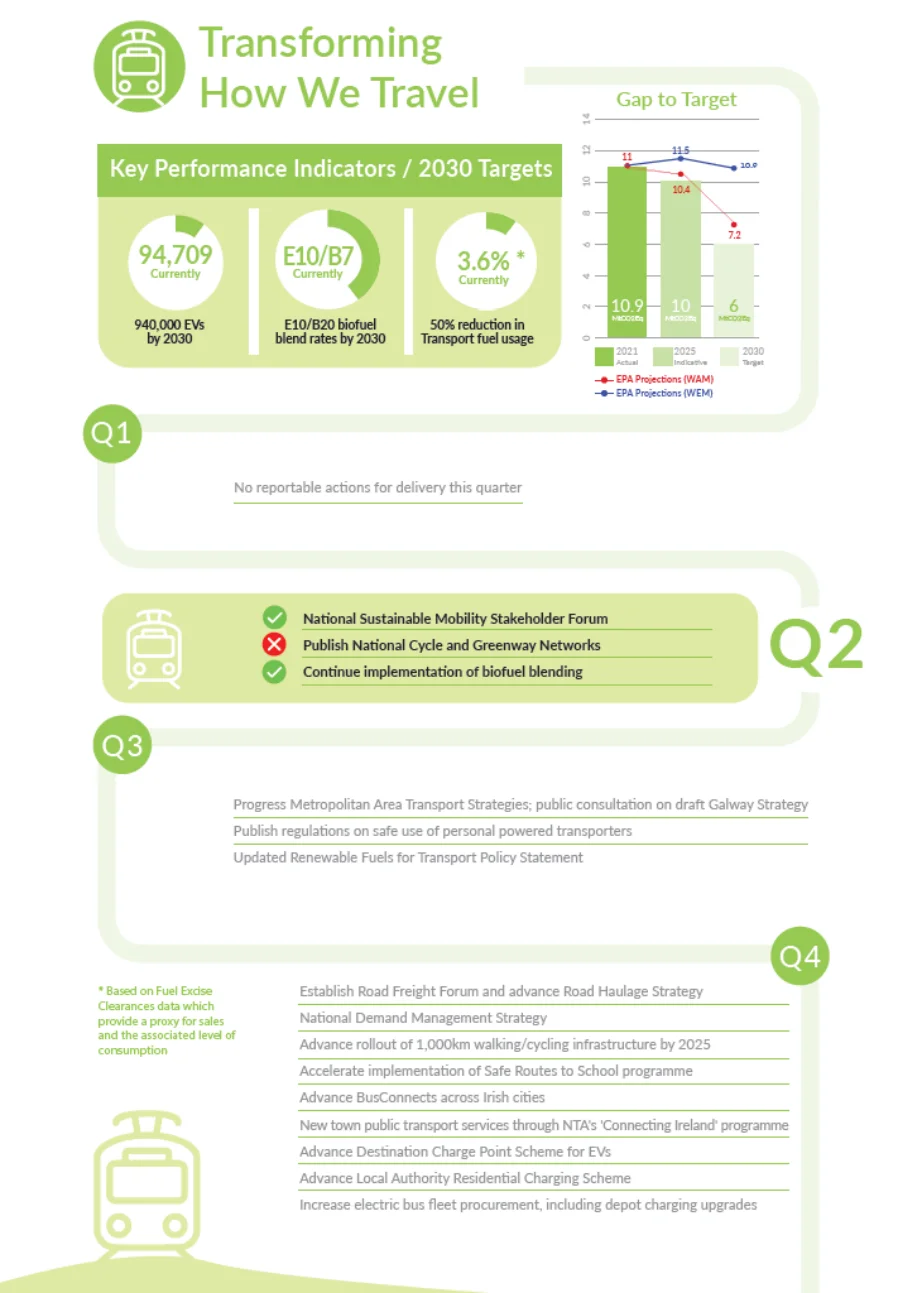
Figure from page 14
| High Impact Action Completed in Q2 2023: Transport | ||
| Did You Know? Although there is an increasing shift to electric vehicles in Ireland, it will | ||
| take some time for the entire national transport fleet to move from fossil fuels. In the | ||
| meantime, increasing the biofuel blend rates in diesel and petrol is one way of reducing | ||
| emissions from this sector. | ||
| What’s new? Under Action TR/23/62, the move to E10 in petrol (meaning up to 10% is | ||
| made up of bioethanol) took effect on 1 July 2023. This followed a consultative process | ||
| and an extensive public awareness campaign. The Department of Transport launched | ||
| the second phase of the public awareness and information campaign print, radio, digital, | ||
| and social media advertising, as well as information displays at forecourts in Q1, | ||
| referring consumers to www.gov.ie/E10 for further information. The tailpipe emission | ||
| savings from different renewable energy sources in transport in 2022 is estimated at over | ||
| 0.7Mt CO2eq savings relative to 2018. The biofuel policy measures implemented in 2023 | ||
| are expected to deliver a further 0.2Mt CO2eq GHG emissions savings relative to 2018. |
| High Impact Action Delayed in Q2 2023: Transport | ||
| Did You Know? Action TR/23/30 under CAP23 sought the publication of a National | ||
| Cycle and Greenway Network to help progress infrastructure rollout. The development of | ||
| the National Cycle Network is substantially complete, but refinement of an accelerated | ||
| delivery schedule is ongoing. This will require further consideration of the funding | ||
| needed to enable the delivery schedule. This has impacted the Q2 delivery timeframe. | ||
| Why is it needed? Road transport is currently highly dependent on fossil-fuelled cars | ||
| i.e., petrol and diesel. Shifting from this dependence to other forms of transport like | ||
| public transport, walking and cycling will require behavioural change supported by viable, | ||
| sustainable, and accessible alternatives. Active travel infrastructure will be part of the | ||
| multi-faceted approach to reducing transport emissions. The National Cycle Network will | ||
| inform the establishment of a coherent and coordinated network that integrates existing | ||
| and proposed cycle routes linking urban centres across the country. It is intended that | ||
| the National Cycle Network will be submitted to Government in Q3 with publication then | ||
| expected to take place. |
Pages 13–15 · View in original PDF