Intercity Spine
Intercity Spine
Journey times
The island of Ireland’s current intercity passenger rail service falls significantly short of the level of service widely available in Western Europe.
An attractive all-island intercity passenger rail service should deliver journey times between the island’s major cities that are materially faster than car journeys. This suggests passenger rail intercity journeys should aim to achieve an average speed higher than average speeds achieved on the island’s motorways, which have maximum speed limits between 100 – 120 km/h (62 – 75mph).
•Journey times are often uncompetitive with car journey times on most intercity routes.
•Service frequencies are less than one train per hour between all seven key cities, except for Dublin – Cork.
Evidence from Great Britain and Europe suggests that to achieve an average speed of 120 km/h, intercity rail services need to operate at speeds of up to 200km/h (125mph). This ensures that, even when allowing for stops, waiting times, and interchange times, the railway delivers a faster journey than the car.
•Connectivity limitations between the South/West and North/East sections of the rail network (focused on Heuston and Connolly stations) means it can be difficult to travel directly between Belfast and Derry ~ Londonderry on one side and Cork, Galway, Waterford, and Limerick on the other by rail.
Significant upgrades to signalling, track condition, level crossings, and rolling stock will be needed across the island’s rail network to achieve a 200km/h railway. It may be possible to deliver some of these enhancements through Iarnród Éireann and Translink’s existing asset renewals programmes.
•Feedback from the initial public consultation that there is an aspiration from the public to improve the quality of service provided by current intercity services. Some aspects of the railway that drive service quality are addressed in this section (e.g., speed and service frequency), while others are considered in the “Customer Experience” section below (e.g., on board experience).
High Speed Rail
The Review has considered whether developing a new, fully segregated, 300 km/h (186mph) high speed rail network could be a viable proposition for the island of Ireland.
Both Iarnród Éireann and Translink are investing in improving line speeds and increasing service frequencies. For example, in the relatively near future, it is envisaged that the Dublin – Belfast Enterprise service will operate hourly. However, if both jurisdictions wish to deliver a world-class passenger rail service between the largest cities on the island of Ireland, then significant interventions will be needed to improve journey times, service frequencies, and cross island connectivity.
While this scenario could deliver transformational improvements in journey times between the island’s largest population centres, analysis undertaken for this Review suggests the benefits of delivering this network would be significantly outweighed by the costs. Given the distance between key population centres, there are diminishing economic returns in targeting speeds above 200km/h.
Furthermore, developing a large new rail network would likely have a significant adverse impact on the natural environment and would risk generating more carbon through construction than would be offset through attracting more demand to the railways.
To better connect northern and eastern parts of the island to the South and West, the Review recommends a long-term intervention that transforms east–west connectivity between Heuston and the Dublin – Belfast corridor, with interchange stations in Dublin City Centre, should also be considered. The concept for an eastwest tunnel in Dublin has been studied extensively in the past, largely in the context of an expanding DART or Dublin mass transit system. It has been cited in several strategic documents in the past by both the National Transport Authority and Iarnród Éireann.
This is not to say new intercity railways should be ruled out – indeed, the evidence suggests a mix of online and offline improvements will be needed to deliver the Goals and Objectives of this Review.
Figure from page 54
Service frequencies
In the short term, some frequency enhancements can be delivered with existing infrastructure thanks to the planned procurement of additional rolling stock. However, to achieve a step change in frequencies and operating performance, it will be necessary to add capacity on sections of the rail network where there is a high level of conflict between intercity, freight and local commuter rail services. This is particularly relevant on busy sections of the railway on the approaches to Dublin and Belfast, and on singletracked sections of the railway such as Portarlington – Athlone.
The development of such a solution will obviously need to be aligned with the development of the rail network within the Greater Dublin Area generally. The Transport Strategy for the Greater Dublin Area 2022 to 2042 proposes to protect and preserve an alignment for a cross- Dublin tunnel for delivery post 2042, and it is recommended that any such proposal considers fully the implications of this Review for the tunnel’s alignment, functionality, and delivery.
Considering this context, this Review encourages policymakers to consider whether this intervention could support longer distance services such as direct services between the island’s largest cities (e.g., Belfast – Cork) and Dublin Airport (e.g., Cork – Dublin Airport), as well as medium distance commuter services (serving stations as far out as Athlone, Portlaoise, Kilkenny and Drogheda). A future east-west tunnel would almost certainly include interchange stations with the planned MetroLink underground line and DART network. In addition to boosting connectivity across Dublin, this intervention would help relieve pressure at terminus stations at Connolly and Heuston and stimulate development and regeneration in the areas served by new underground stations.
Most capacity can be delivered by building additional track, upgrading junctions, and adding platform capacity in some places. These improvements could be delivered in parallel with line speed improvements. In some cases, it may be easier to develop new lines rather than deliver dual or four-tracking upgrades on existing corridors, such as between Drogheda and Clongriffin.
Cross-island connectivity
In the longer term, and in line with the Review’s goals of improving all-island connectivity between the major cities, consideration will be required as to the optimal solution for cross-Dublin services.
Recommendations
•Upgrade the core intercity railway network to line speeds of up to 200km/h (125mph) by:
The Review has considered the costs and benefits of potential solutions to the alignment and capacity constraints outlined above, as well as their impact on the environment. This work has informed the recommendations set out below.
oUpgrading the condition and
strength of straight sections of track.
In summary, to deliver a world-class allisland intercity railway that meets the Goals and Objectives of this Review, governments in both jurisdictions should develop plans to:
oRealigning some sections of the
railway where steep curves and level crossings currently force trains to reduce speeds.
oProviding capacity to segregate
•Upgrade the cross-country rail network to a dual-track railway (and four-tracks in places) and increase intercity service frequencies.
4
intercity and regional services from other services on busier sections of the railway, which could include loops on busy sections to accommodate growth while longer term solutions are developed.
●This would involve dual-tracking the railway between Portarlington – Athlone, Kildare – Kilkenny, and Maynooth – Mullingar and four-tracking Connolly/Spencer Dock – Clongriffin.
oUpgrading signalling and rolling
stock – which could be delivered incrementally as part of a wider renewals programme.
●In addition to enabling higher frequency intercity services on these corridors, these improvements would allow more commuter services to serve intermediate stations and thus enable intercity services to deliver faster cityto-city journey times.
Recommendations (Continued)
•Develop short sections of new railways on congested corridors. There are three sections of the network that are likely to require a four-tracking or new rail alignment solution to accommodate conflicting demands for capacity and deliver a 200 km/h railway. These three sections are:
This railway would be shorter than a four-tracked solution, deliver faster journey times, require fewer significant crossings, require less land and property acquisition, generate less disruption to existing services during construction, and would have a more limited impact on the environment.
oBelfast – Lisburn – Newry: The
existing railway between Newry and Belfast has significant constraints due to its alignment, level crossings, and limited space to add capacity between Lisburn and Belfast. A new railway could deliver significant journey time and capacity benefits for this corridor.
oPortarlington/Kildare –
Hazelhatch: This railway is also expected to become busy as the commuter market to the South West of Dublin grows. It should be feasible to four-track the corridor as far as Portarlington but doing so would have some impact on towns on the route and would involve building tracks through the Curragh. An alternative option could be to build a new alignment from Hazelhatch to Portarlington (with a spur to the Waterford line) that avoids the Curragh. This route would be shorter and could deliver faster journeys.
oDublin – Drogheda: This railway
is expected to become busier when the DART network is extended to Drogheda MacBride. While it is probably technically feasible to four-track this railway – notably between Connolly and Malahide – four-tracking some sections may result in a significant adverse effect on the integrity of several Special Protection Areas and potentially the waterfronts of Malahide and Balbriggan. An alternative approach could be to build a new railway from Drogheda to Clongriffin following the M1 corridor.
•Develop a cross-Dublin solution. An east-west railway from Heuston to Spencer Dock could deliver transformational improvements in cross-island connectivity if combined with improvements north of Connolly.
A map illustrating the interventions that are likely needed to deliver a fast, frequent, and high-quality intercity railway service is shown in Figure 10.
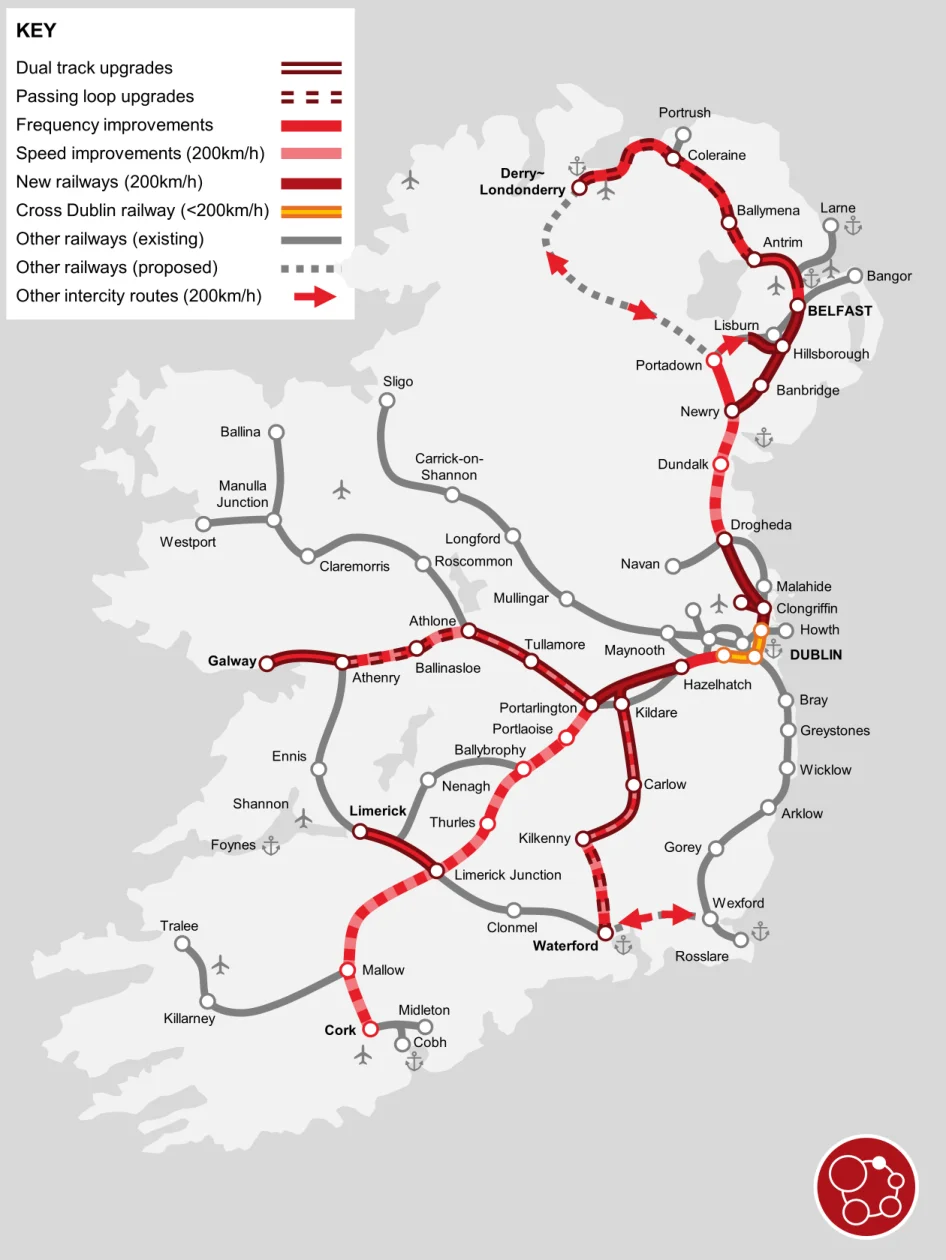
Figure 10
Figure 10 Intercity network interventions
| Case Study | Denmark | This aims to reduce travel time to under one hour between each major city pair, increase the accessibility of regional cities, and enable them to play a stronger role in the economy. This programme of investment has included delivering Denmark’s first high- speed railway line, which runs between Copenhagen and Ringsted on the route to Odense and was completed in 2018. This line relieves congestion on busy commuter routes on the key corridor from the west of the country to Copenhagen. Further investments in high speed railways from Odense to Aarhus to Aalborg are planned. Today, Denmark’s railway delivers average speeds between its major cities that, in some cases, are twice as fast as current speeds between major cities on the island of Ireland. Denmark has achieved these improvements largely through investing in the existing network, with one short section of new railway on a congested corridor. Economic assessment indicates that – based on future projections – the “Hour Model” will be a profitable project. The investment in rail infrastructure improvements have been forecast to have a Net Present Value of between DKK 11bn and DKK 7.6bn (€1.5bn/£1.3bn - €1bn/£0.8bn) for New Construction Budgeting surcharges of 10% and 50% respectively. This project will also help improve agglomeration between Denmark’s key cities, and boost productivity nationwide. This case study illustrates the benefits that a faster, higher capacity intercity rail provides for a country with similar socioeconomic and geographical characteristics to the island of Ireland. | ||
| Denmark shares many similarities with | |||
| Ireland. It has a similar population size, | |||
| and its economic geography is highly | |||
| centred on a large metropolitan area on | |||
| the eastern side of a large island. Denmark | |||
| held a strategic review of its railway in | |||
| 2006 and identified similar challenges that | |||
| the island’s railways face today, including: | |||
| • Low levels of electrification; | |||
| • Capacity constraints, especially on | |||
| main lines into the capital city; | |||
| • Conflicts between intercity, regional, | |||
| suburban, and freight services; and | |||
| • Speed restrictions and poor alignments, | |||
| resulting in relatively slow journeys. | |||
| To achieve a modern railway, Denmark | |||
| developed, and has started to implement, | |||
| a new plan, Togfonden DK (Train Fund | |||
| Denmark) since 2014. | |||
| Most of the funds in Togfonden DK are | |||
| used for large investments in new and | |||
| faster rail connections, including faster | |||
| travel times on most regional lines, an | |||
| upgrade to support transport of rail freight, | |||
| and extensive electrification of the network. | |||
| Several upgrades to the railway network | |||
| have since been planned and completed to | |||
| reduce journey times between major cities | |||
| in the country and the achievement of a | |||
| concept called the Hour Model. |
Pages 53–58 · View in original PDF