Freight
Freight
Despite recent challenges, the Iarnród Éireann Rail Freight 2040 Strategy aims to grow rail freight towards levels seen in Europe and provides a framework to achieve this goal.
Rail freight is something of a “niche” activity on Ireland’s railways today. The railway supports some outbound freight flows from Mayo to Waterford and mining products from Tara Mines to Dublin, as well as inbound intermodal freight from Dublin and Waterford to the North West. However, the competitiveness of rail freight has been significantly eroded in recent decades and volumes have fallen from c.4 million tonnes in 1981 to c.0.3 million today (which is less than 1% of modal share).
This Review has explored opportunities for increasing rail freight’s market share so that it is broadly comparable to similar countries and recognises that future rail freight growth will come from modal shift (rather than organic growth). This will help reduce carbon emissions, improve air quality, reduce road noise and congestion, and support regional economic development.
There are also opportunities to develop inland rail freight terminals to serve the largest urban and industrial areas across the island – including areas in Northern Ireland. These large multi-purpose rail freight interchange and distribution centres would be ideally linked to both the rail and strategic road networks. They could play a role in helping reverse rail freight’s recent decline on the island.
As Figure 15 below shows, in 2019 Ireland recorded the lowest level of rail freight mode share in the European Union (excluding Member States that have no railways). Northern Ireland (which is in the UK figure below) currently has no regular rail freight operations. There are several factors driving this trend, including changes in freight and logistics patterns, the development of Ireland’s motorway network, and many of the railway’s infrastructure constraints outlined in Chapters 2 and 3. The cost of rail freight versus road freight, including relatively high track access charges levied on operators, is also an issue.
There are also opportunities to improve the efficiency of transferring freight between rail and sea transport. Currently, the rail network can only accommodate Load-on/Load-off (“LoLo”) cargo movements, but some European railways can also accommodate Roll- On/Roll-Off (“RoRo”).
80
Rail freight mode share (%, 2019)
70
60
50
40
30
20
10
0
Figure 15
European countries’ rail freight mode share (source: Eurostat, 2019)
Approach
Dublin Port will play a key role in helping grow rail freight in Ireland. The 2040 Dublin Port Masterplan plans for growth through consolidating the existing estate and expanding on the Poolbeg peninsula. Rail connectivity to the current port area is poor – part of the railway runs on and across busy roads, creating significant conflicts with road traffic – and there is currently no rail connectivity to Poolbeg. These challenges will need to be addressed to realise the objective of growing rail freight in Ireland to reduce road congestion and decarbonise the transport system.
The Iarnród Éireann 2040 rail freight strategy proposes to increase Ireland’s rail freight’s mode share “in line with other European countries”. Given Ireland’s geographical context as an island situated some distance from the core rail freight corridors of Europe, it seems reasonable to target the level of mode share that is currently achieved by other island and/or peninsula railways in Europe. This ranges from 3% in Greece to 30% in Sweden, but most countries in this category appear to lie in the 5 – 10% range. This Review has therefore considered how the railway could support a level ofrail freight mode comparable to western European countries – around 10%, which reflects an ambition to use rail freight to decarbonise the island’s transport system. This will likely require interventions to support higher outbound flows, which tend to focus on the South Coast ports, and higher inbound intermodal flows, which are likely to target the island’s largest cities. There are also opportunities to leverage recent adjustments to trade patterns between Ireland, the UK mainland, and Europe to support rail freight flows between the island’s South Coast ports and the European mainland.
Strategic options
To grow rail freight in the island of Ireland, the Review has considered the following:
•Rail freight needs be price competitive with road freight, and it needs to connect major freight producers and customers together in a reasonable time. This means the railway needs to connect seamlessly to Ireland’s busiest ports and connect with inland rail freight terminals that serve the island’s largest population and industrial areas. This also means ports connected with the railway should enable the LoLo cargo movements, although it is noted that in some European countries increased levels of RoRo cargo movements are being handled via rail also, which warrants consideration in Ireland.
Future rail freight services within the island of Ireland are likely to be most viable where there is a sufficient critical mass of cargo movements (in terms of tonnes-lifted). In general, this means rail freight is likely to be competitive on corridors that support at least one million tonnes per annum of road freight covering distances above 100km. This suggests the greatest potential for intermodal rail freight will focus on routes between Dublin and the largest cities on the island of Ireland, while the greatest potential for outbound flows is from the North West to the South Coast ports.
•Rail freight must enable seamless movements between ports and inland terminals. This means key freight corridors must have the capacity to accommodate freight services and minimise conflicts with other rail users.
•Rail freight should be provided with access to decarbonised forms of railway traction.
Many of the interventions outlined earlier in this Chapter will support rail freight. These include:
Additionally, there will need to be enhancements to current ports and inland terminals, and the development of new inland terminals to serve the island’s largest industrial areas. While it is not the role of this Review to recommend specific locations for these terminals, it is considered that at least one terminal should be developed for the largest cities on the island of Ireland – ideally at locations with good road access, and where the railway is well suited to accommodating freight traffic. Further assessment will be needed to establish ideal locations for these terminals. To serve these terminals, there would need to be an increase in freight rolling stock capacity (both locomotives and wagons).
•Developing a new railway to link between Limerick – Foynes.
•Reinstating the railway between Claremorris – Athenry to enable rail freight from the North West to access the South and Mid West while avoiding the busy Dublin – Cork line (and the need to reverse at Kildare).
•Reinstating the railway between Rosslare – Waterford. While there is currently no rail freight traffic from Rosslare Europort, in the longer term this port could be developed to accommodate LoLo movements.
The Review has considered options for improving connections to the Port of Belfast and Ringaskiddy. In these cases, it was found that developing new rail links would be very costly and disruptive and would encourage freight traffic to use parts of the railway that are already quite congested. Alternative options for Belfast include developing an inland terminal to the South West of the city and alternative options for Ringaskiddy include connecting to Marino Point near Cobh.
•Reinstating the railways between Athlone – Mullingar – Portadown and adding capacity between Dublin – Mullingar. This will provide alternative routes between Dublin and the North and West (avoiding intercity routes).
•Adding capacity on corridors used by rail freight today, and that could be used in the future, including Dublin – Athlone, Dublin – Drogheda, and Limerick – Waterford.
•Considering opportunities to better connect other ports to the railway where it runs close to ports such as Marino Point near Cobh.
The Review has also analysed the economics of rail freight in Ireland and established that track access charges – which are reportedly among the highest in Europe – present a major barrier to growth. Analysis undertaken for this Review suggests bringing these charges closer to the levels that are typically levied in the EU should help stimulate growth in rail freight in the short term.
Recommendations
Strengthen rail connectivity to the island’s busiest ports where links are feasible and improve access to ports that currently are underserved by rail freight, including Foynes for Limerick, Waterford, Marino Point for Cork, and Rosslare Europort (in the longer term, when LoLo operations are feasible here, or, in the shorter term following analysis of the feasibility of RoRo rail freight).
To grow the island’s rail freight industry and support the freight Objectives of this Review, both jurisdictions should develop plans to:
•Develop a sustainable solution for first-mile-last-mile rail freight access for Dublin Port. Without this connection, there are limited options for growing rail freight.
21
•Develop a network of inland terminals close to major cities on the rail network, especially where there is good access to major roads/motorways, limited impact on communities and passenger traffic, and good access to industrial clusters. Potential locations for new terminals include the Upper Bann area for Northern Ireland, Limerick Junction, a location north of Cork, Athenry for Galway, Sligo, and west of Dublin.
24
•Reduce Track Access Charges for freight services. These charges are high compared to other European railways but could be reduced through support/government subsidy to stimulate demand for rail freight.
22
These interventions will enable freight services to operate on routes that avoid many busy intercity routes, as shown in light blue in Figure 16.
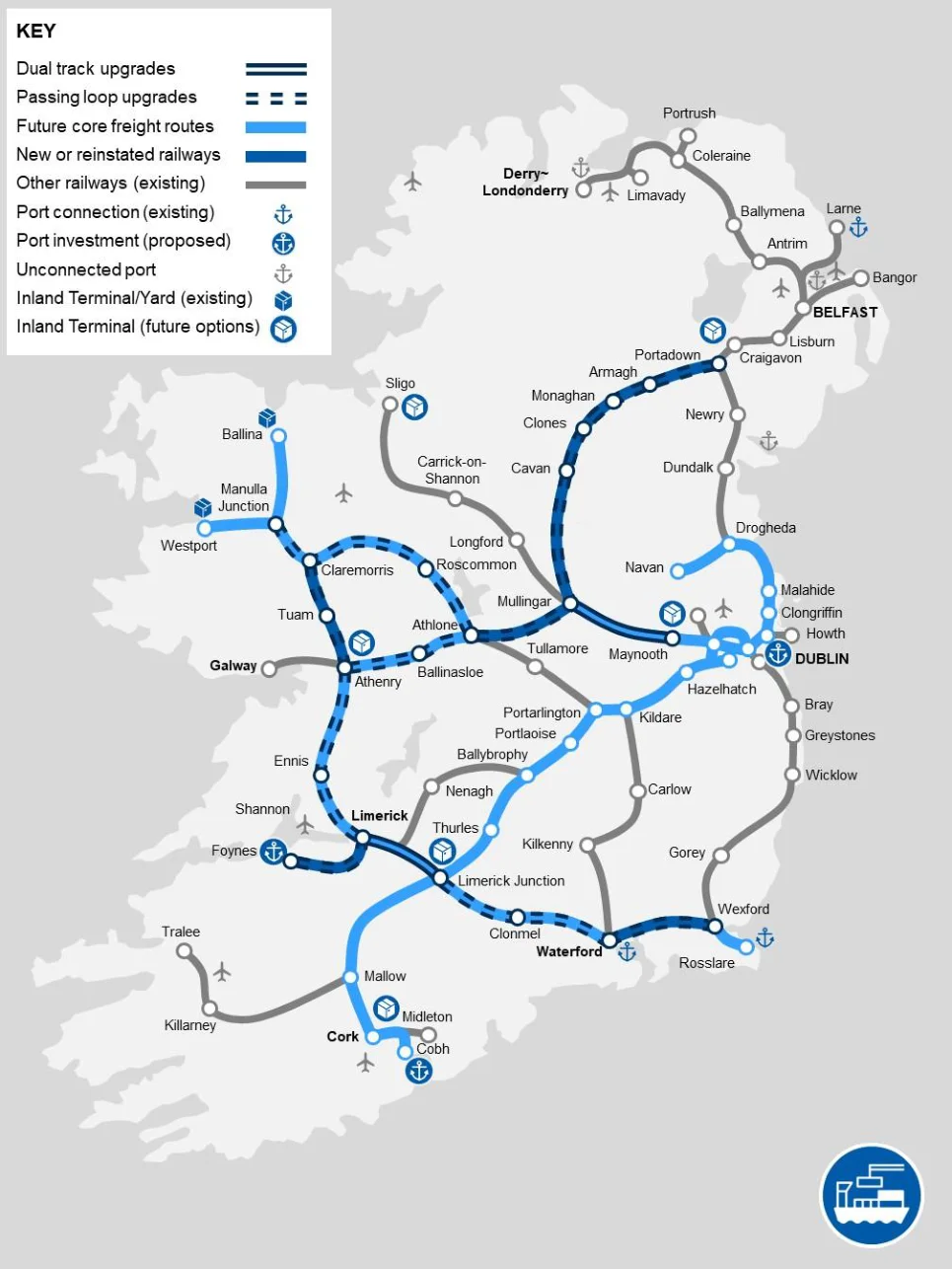
Figure 16
Figure 16 Rail freight interventions
Case Study | New Zealand
The New Zealand Rail Plan identifies several challenges that could hold back growth of rail freight. While some of these are external to the industry (e.g., COVID- 19), there are many operational restrictions and gaps in electrification across the network. To address these challenges plan, the government has committed to invest in:
•A longer-term sustainable programme of maintenance and renewals; and
New Zealand is an island nation with a similar population to Ireland but is more isolated from its nearest neighbours. As in Ireland, rail freight in New Zealand is used for moving imports and exports to and from major ports as well as carrying bulk commodities such as logging.
•A programme of intergenerational replacement of locomotives, Interislander ferries, wagons and shunts, and modernisation of facilities reaching end of life.
KiwiRail (a state owned enterprise) manages the 4,000km rail network and operates both freight and passenger services. The network is split into two parts, one on the North Island and the other on the South Island. Both islands are connected by the Interislander ferry service, which can carry rail vehicles. The rail network outside of cities is largely dedicated to freight (see map to the right).
Funding for these investments will come through the National Land Transport Programme under the new planning and funding framework, with support from the Crown and track users. The first tranches of funding have already been committed to a range of projects, including core asset maintenance, intergenerational asset replacement of rolling stock and Interislander ferries.
Rail freight’s mode share in New Zealand is much higher than in Ireland. In 2017/18, rail freight’s mode share was 11.5% for all goods and much higher in coal, paper, dairy, and meat products. KiwiRail operates more than 900 freight trains per week, or around 130 a day. While rail’s freight share has remained steady in recent years, there are concerns the industry will stagnate without intervention.
Thanks to recent investment, some ports have experienced significant growth in rail freight demand. For example, the Lyttelton Port Company saw significant growth in demand and subsequent rail freight services, with weekly services increasing from 2-3 per week in 2016 to 16 per week by 2020. The port estimates that this takes 120 heavy vehicles off the road each day. The port also notes that customers see rail freight as a key component of reducing the carbon emissions associated with their products. A new weekday rail service between Auckland and Christchurch is also being launched to help New Zealand businesses recover from the pandemic.
The Government considers rail an essential part of the freight industry, providing resilience through offering an alternative transport option for importers and exporters. Investing in restoring the rail freight network is one of two strategic investment priorities in the recently published 2021 Rail New Zealand Plan, which sets a framework for delivering a resilient and reliable rail network.
New Zealand shows it is possible for rail freight to compete and succeed on an island network.
Pages 77–82 · View in original PDF